I Ching for Love: How to Ask About a Relationship
Somewhere around the third reading in, almost every I Ching user asks about love. It is the most natural question in the world and, paradoxically, one of the easiest to ask badly. "Will we stay together?" produces a flat, anxious reading. "What do I most need to understand about where we are right now?" produces something you can actually use. The difference is not in the coins. It is in the wording. This guide shows you how to phrase a love question so the hexagram has something real to answer, which hexagrams you are most likely to meet in a relationship reading, and how to read those hexagrams in the right order.
Note before anything else: the I Ching is a structured reflection tool, not a psychic wiretap. It cannot see inside your partner's head, and it is not going to give you a dating verdict you could not have reached with a long, honest conversation. What it does well — extremely well — is turn a foggy feeling into a question with edges.
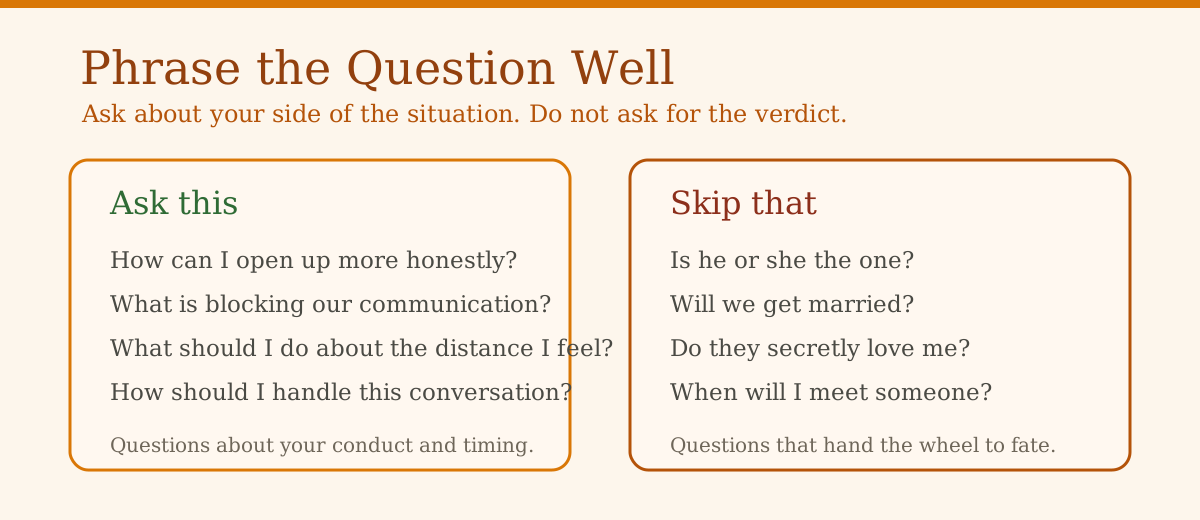
- Ask about your side of the situation. "How should I handle the distance I feel?" beats "Does she still love me?" every time.
- One question, one cast. The classic text itself warns that a third, impatient re-ask goes unanswered.
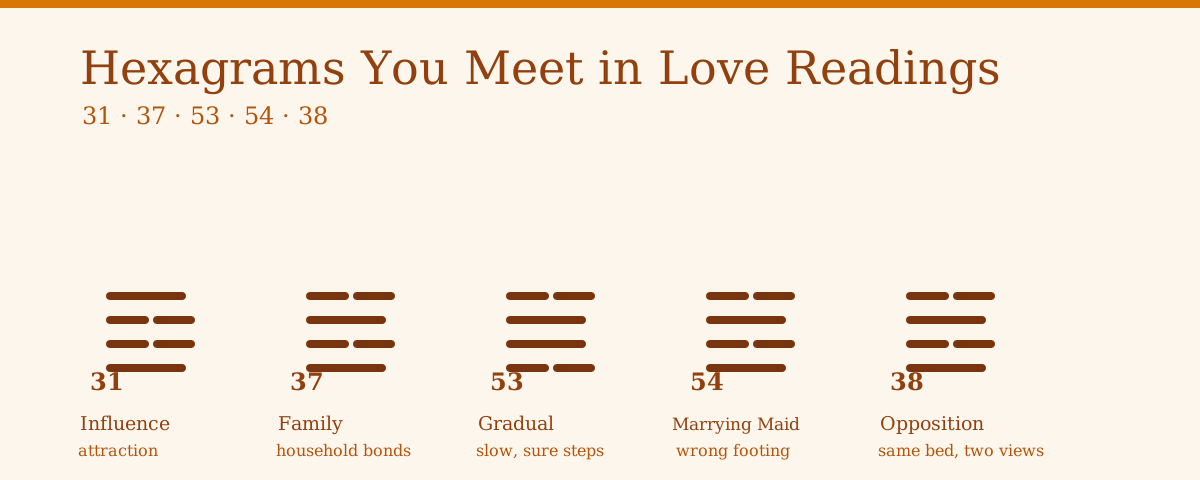
- The six hexagrams you will meet most in love readings: 31 Influence (咸), 37 Family (家人), 38 Opposition (睽), 53 Gradual (渐), 54 Marrying Maiden (归妹), and 61 Inner Truth (中孚).
- Read in four layers: the Judgment, the two trigrams (lower = you, upper = your partner or the situation), any moving lines, then the derived hexagram.
- Want to try it right now? Cast a free hexagram — no account, two minutes.
Why Love Is the Question People Ask First
Ask any reader who has taken casts professionally, and they will tell you the same thing: romance is the volume leader, and it has been since long before the internet existed.
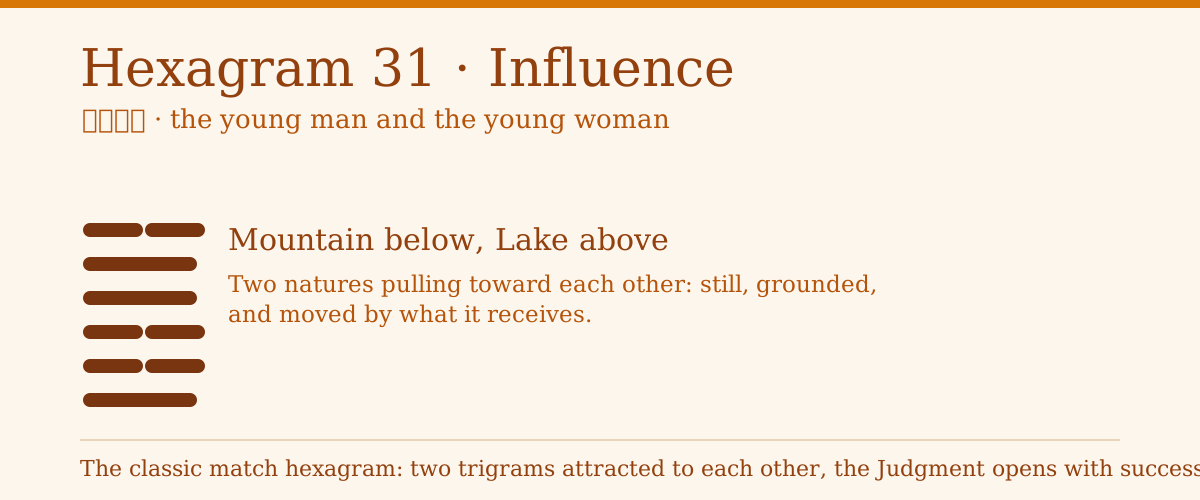
The I Ching was already an oracle of record in the early Zhou dynasty, and marriage — who to marry, when, and into whose family — was one of the questions kings and court diviners cast before major decisions. The core text is full of marriage imagery for a reason. Hexagram 31, Influence (咸), was traditionally read as the attraction between a young man and a young woman, and its Judgment in the old translations opens with success and calls the fortune of a maiden good. Hexagram 53, Gradual (渐), is the marriage that proceeds slowly and correctly — the wild goose advancing step by step, the old commentaries said; its Judgment speaks favorably of a maiden's marriage in the right time. Hexagram 54, Marrying Maiden (归妹), is marriage entered under the wrong conditions, where the classic text warns that movement brings misfortune.
So love is not a modern hijacking of an old book. The book grew up with courtship questions built in. What has changed is the asking style. The old questions were social and procedural: this alliance, this timing, this household. Ours tend to be psychological and private: does this person feel what I feel, and will it last. Neither is forbidden. But the book's answers are built out of situations, not verdicts, which means the wording of your question decides how useful the answer can possibly be.
That is the single most important sentence in this guide: the I Ching answers the question you actually put to it, so a vague question gets a vague answer, and a question about someone else's feelings gets a reading about your own anxiety wearing a costume.
A good love reading does not tell you who to marry. It shows you, in a three-thousand-year-old vocabulary, what your situation looks like when you stop squinting — and what you can do from there.
Ask a question phrased the way this guide suggests, and see what the weather report says. The app marks your moving lines, builds the derived hexagram, and walks you through the reading in plain English. And if this is your first time through a full reading, do it in the right order: start with how to interpret your reading, then cast when you have a question worth asking.
Cast a free hexagram nowHow to Phrase a Love Question the I Ching Can Answer
A well-built love question has three properties. Test yours against them before you cast.
1. It is about something you can act on. The hexagram describes a situation and how it is developing; it rarely hands you someone else's inner state. "How can I become someone my partner wants to open up to?" is answerable. "Will my partner ever open up to me?" is not, because the second version outsources the reading to a mind you cannot inspect. Keep the question inside the circle of things you actually control.
2. It is single and specific. Not "what is my love life like" — that is a topic, not a question. "What should I understand about the coldness that started after I moved for work?" is a question. A question names one situation, one relationship, one conversation. If you find yourself writing "and" more than once in the question sentence, split it.
3. It is open to a direction, not rigged for a verdict. The classic trap is the yes/no-shaped wording: "Is he the one?" The I Ching, read honestly, almost never answers that cleanly, because almost no real situation reduces to one word. Far better: "What do I need to see clearly before I decide whether to keep investing in this?" That reads like a blessing and it reads like a warning with equal ease, which is exactly what you want from a mirror.
Three starter templates that consistently produce good casts:
| Template | Example | Why it works |
|---|---|---|
| "How should I handle…" | "How should I handle the conversation about moving in together?" | Names your action, not the outcome |
| "What is blocking…" | "What is blocking warmth between us lately?" | Points at an obstacle you can look at |
| "What do I most need to see about…" | "What do I most need to see about my pattern of choosing unavailable people?" | Asks for a blind spot, which the text is excellent at finding |
If your question fits one of those three shapes, you are already better off than most people who cast about romance.
For the mechanics of casting itself — coins versus yarrow versus the app, and whether time of day or lunar phase matters — we cover the options in how to cast the I Ching and in our coins vs yarrow vs online comparison. The short version: method barely matters; the wording matters enormously.
Love Questions That Work — and Ones That Don't
Here is the same principle in table form, because it is worth being able to check at a glance before you throw the coins.
| Ask this | Instead of this | Why |
|---|---|---|
| "How can I communicate my need for space without pushing her away?" | "Is she mad at me?" | The first can be answered; the second can't be verified |
| "What is the healthiest way to approach our finances together?" | "Will we get married?" | Marriage verdicts depend on a future neither of you can see yet |
| "What do I need to understand about why this keeps ending the same way?" | "When will I meet 'the one'?" | The book reads your pattern, not the calendar |
| "How should I handle discovering the messages last night?" | "Is he cheating on me?" | Facts about others are unknowable through coins; conduct is not |
| "What does this relationship need more of right now?" | "Are we soulmates?" | Big metaphysical labels flatten rich situations |
| "How should I proceed: deepen, pause, or clarify the terms?" | "Should I break up?" | A real choice beats a referendum on destiny |
Read the right-hand column out loud once, and you will hear the pattern: they are all fortune-teller questions — verdicts about other people, about the future, about cosmic labels. The left-hand column is all conduct questions — what you can do, say, understand, and choose. The I Ching is a book of conduct before it is anything else. Feed it conduct questions and it rewards you; feed it verdict questions and it will still answer, but it answers with the only thing it has: a description of the situation, which you will then misread as a verdict.
One more rule that deserves its own paragraph: one cast per question, per week is plenty. Hexagram 4, Youthful Folly (蒙), the hexagram about asking and learning, contains the oldest piece of divination etiquette in the book — roughly: the first sincere ask is answered; importune it again and again and it stops answering. Modern translators turn it into "ask once, ask well." If you are re-asking the same question because you did not like the answer, the answer was probably doing its job.
The Hexagrams You Meet in Love Readings
Certain hexagrams show up in relationship questions so often that learning their names in advance is like learning the landmarks before driving a new city. Here are the six you will meet most, with what the tradition actually says about each.
| Hexagram | Name (Chinese) | Traditional image in love readings |
|---|---|---|
| 31 | Influence (咸) | Mutual attraction; mountain below receiving the lake above; reading its Judgment as good fortune for a young woman has been standard since the oldest commentaries |
| 37 | Family (家人) | The household order — roles, responsibilities, loyalty within the home; wind spreading from the fire of a well-run family |
| 38 | Opposition (睽) | Two people who see the same facts two ways; fire burning upward while the lake seeps downward — the Judgment famously allows only small things to go well |
| 53 | Gradual (渐) | The slow, correct advance, classically the marriage that proceeds step by step like the wild goose; patience is the whole message |
| 54 | Marrying Maiden (归妹) | Marriage or commitment entered under the wrong conditions — bad timing, wrong motive; the Judgment warns that movement brings misfortune |
| 61 | Inner Truth (中孚) | Sincerity that moves even animals; if there is a "does the relationship have honest ground to stand on" hexagram, this is it |
Two of these deserve a closer look, because people misread them constantly.
Influence (31) is not a promise that the relationship is blessed. It describes attraction in motion — the pull that got you here. If you cast it at the start of something new, it reads as genuine chemistry, and that is lovely. If you cast it in year five of a struggle, it is a diagnosis, not a reassurance: you are still being drawn together, so what is drawing you is real, and the question becomes why the pull is not getting through the layers of resentment. Influence is the current; it is not the contract. For the full text and line-by-line meaning, our Hexagram 31 page walks through it.
Opposition (38) is the one nobody wants in a love reading, which is exactly why it is useful. Its Judgment's "small things further" is the ancient version of the couples counselor's advice to start with the dishes, not the marriage. When Opposition shows up, the reading is rarely "leave" and almost never "everything is fine." It is: your two energies have turned away from each other, and if you want to reconnect, start small, start practical, and stop grandstanding about the big existential question for a while.
A quick word on Inner Truth (61) while we are here: it is the hexagram of sincerity that carries weight, and in relationship questions it reads as "the honest core is intact — build from there." It pairs especially well with difficult questions, because it is the rare hexagram that says both "the ground is sound" and "the ground will only hold if you keep it true."
None of these are verdicts. They are weather systems. The same hexagram that describes a happy courtship describes a foundering one, because the situation you bring to the coins decides what the weather means.
How to Read a Love Reading in Layers
When you get a hexagram in answer to a relationship question, do not grab the first sentence of the Judgment and run with it. The reading has four layers, and each one sharpens the layer above it.
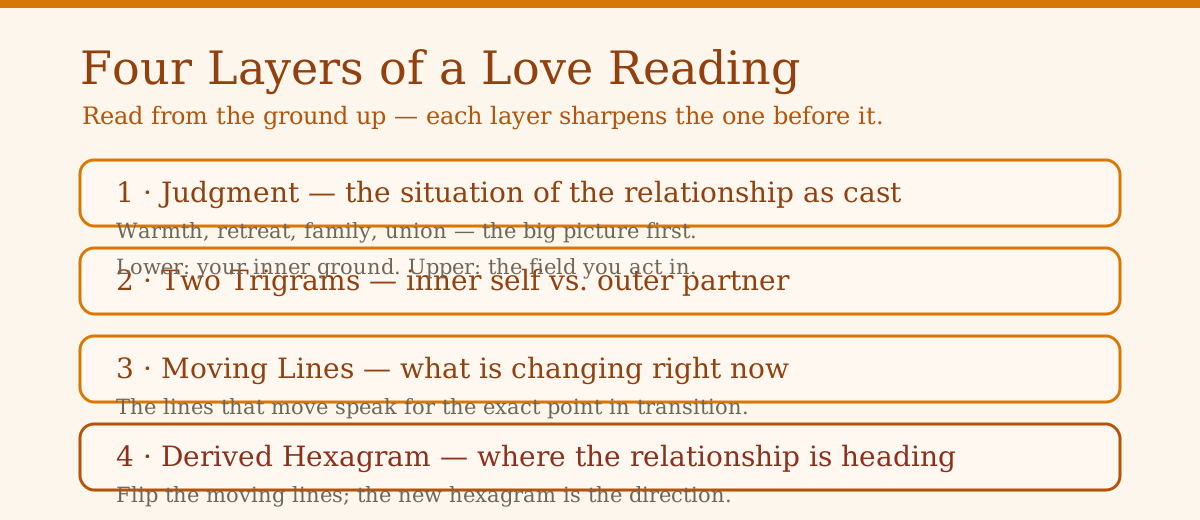
Layer 1 — the Judgment. What is the situation, as cast? The Judgment describes the field: warmth, retreat, union, fracture. Read it as the weather report for the relationship right now, not as the final verdict.
Layer 2 — the two trigrams. Split the hexagram in half. Lower trigram, inner: the house you are standing in — your ground, your inner state. Upper trigram, outer: the field — commonly read in love questions as your partner, or the shared situation you act inside. When the two trigrams naturally attract (mountain and lake in 31) the reading leans warm. When they diverge (fire up, lake down in 38) the reading leans strained. This is the oldest structural read in the book and the one beginners skip most.
Layer 3 — the moving lines. These are the exact spots in the situation that are in transition, and they speak directly. A moving line is almost always more precise than the Judgment itself, so if your cast has moving lines, they are the heart of the answer. Read them bottom-up, as the text is written. One moving line, in particular, can completely change the temperature of a Judgment that looked encouraging.
Layer 4 — the derived hexagram. Flip every moving line to its opposite and you get a second hexagram: not a prophecy, but the direction the situation is heading if nothing changes. In love readings, compare the two hexagrams like before/after photos. Original warm and derived cold? The current runs downhill, and the reading is a warning about inertia. Original strained and derived warm? The movement is carrying you toward better ground — the moving lines will tell you what action triggers that turn.
We walk the full mechanics of moving lines, the derived hexagram, and how to translate all of it into plain language in our reading guide. The short version for love questions: the Judgment is the weather, the trigrams are the two of you, the moving lines are the news, and the derived hexagram is the forecast if you keep the course.
When the Reading Says Something You Didn't Want to Hear
You cast about the relationship you are already grieving, and the hexagram says something you read as "don't wait" or "this is obstruction, not growth." Before you throw anything across the room, run the checklist:
- Did you ask a verdict question? If you asked "will it work out," a difficult answer will feel like a death sentence when it is actually a situation report. Re-check your wording before you re-check your fate.
- Is the reading about timing, not truth? A large share of "bad" love readings are about when, not whether. The dragon hidden in the deep is still a dragon; the Judgment for a line like that is "not the time for active doing." That is not "no," it is "not yet, and here is what you can do while you wait."
- Does it name an obstacle you already knew about? The oracle is astonishingly good at handing you back, in the book's words, the exact thing you have been avoiding saying to yourself. When that happens, you have not been told anything new — you have been shown that you already knew.
A hard reading done right does not dictate. It puts the choice back at your feet with better lighting: you can stay as you are, you can change the conduct the reading points at, or you can leave — and seeing the fork clearly for the first time is the actual gift. If a reading collapses you, take a day before deciding anything. The hexagrams have been around for three thousand years; they can wait twenty-four hours for you to stop shaking.
Common Mistakes When Asking About a Relationship
Asking about a third person's feelings. "Does my ex regret it?" "Is my crush into me?" The coins cannot read another mind, and the reading you get will be a projection of your own state wearing the book's clothes. If you must ask, recast it as conduct: "How should I handle still carrying this?"
Re-asking until the answer is palatable. Twice is impatience; three times is begging. The second and third casts of the same question are famous for being noisier and meaner than the first — the mountain keeps showing you the same face until you stop kicking it.
Reading only the Judgment. In love readings especially, the moving lines carry the news. A warm Judgment with a cold moving line is a different answer from the same Judgment with none.
Interpreting the upper trigram as the entire other person. Your partner is not reducible to one trigram. The upper trigram is the field — the shared situation, the dance, the outside pressure. Keep the reading humble about other minds.
Asking on the day you are most upset. The text is a mirror; a shaken mirror shows a shaken face. If you have to cast the morning after a fight, the reading will be honest about that fight — which is a fine thing to ask about — but do not ask it the same morning for "will this relationship survive," because you will have asked two questions in one cast and gotten a muddle. Wait a day, or split the questions the way the section above describes.
FAQ
Yes — love and marriage questions are among the oldest uses of the book, and the core text is full of courtship and household imagery. The key is wording: ask about your conduct and your understanding, not for a verdict on another person's feelings.
There is no single "good" hexagram, but the ones that come up most in relationship questions are 31 Influence (attraction), 37 Family (household order), 38 Opposition (divergence), 53 Gradual (slow correct progress), 54 Marrying Maiden (ill-timed commitment), and 61 Inner Truth (sincerity). Which one you get depends on your situation — that is the point.
Influence (咸) is the classic match hexagram: mountain below, lake above, two natures pulled toward each other. Traditionally read as good fortune for a young woman's match, in practice it describes genuine attraction in motion — the pull that brought you together, whatever you make of it from there.
No. The coins cannot read another person's mind, and any reading you get on "does she love me" will actually be about your own state and hopes. Ask instead what you can do, understand, or choose — the book answers conduct questions, not telepathy.
The most common cause is the question itself: a vague or verdict-shaped question ("will it last") gets a description it is easy to misread as a verdict. Check your wording, read the moving lines before the Judgment conclusions, and remember the derived hexagram shows a direction, not a destiny.