I Ching With 2 or 3 Moving Lines: How Should You Read Them?
Two or three moving lines is where the I Ching stops being a snapshot and becomes a story with a plot. The short answer to how to read them: read both hexagrams, in order, every time. The original hexagram, 本卦, is the situation as it stands; the derived hexagram, 变卦, is where it is heading. With two moving lines, the two line texts of the original carry the specifics, and when they pull in different directions the upper line leads. With three, the Judgments of both hexagrams carry the weight, original first, and the line texts fill in how the change happens. That is the system in one paragraph. This guide explains why it works, where it came from, and how the different schools of the tradition split the same cast three different ways.
- Two moving lines: read both line texts, bottom to top, and let the upper of the two lead. Then read the Judgment of the derived hexagram for the direction.
- Three moving lines: read the Judgments of both hexagrams, original first, treating the pair as the frame. The three line texts are the detail, not the headline.
- Original or derived? Both, always, in that order. The real question is which one carries the weight, and the count of moving lines decides that.
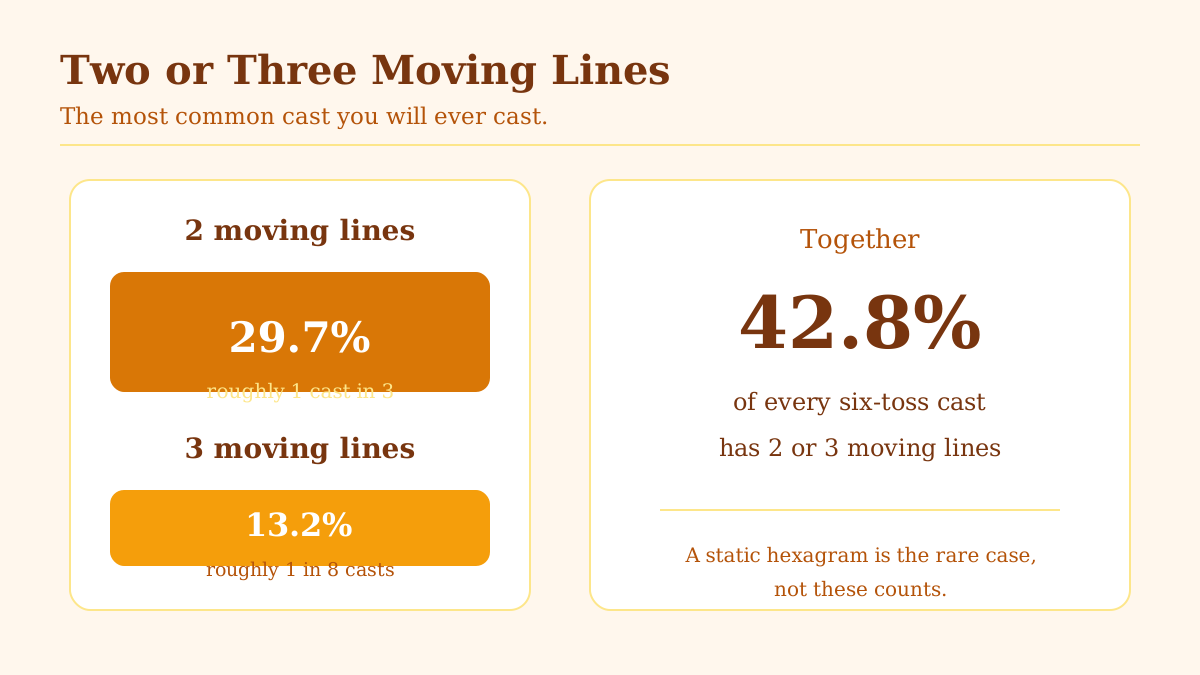
- The counts are normal, not dramatic. Roughly 43% of all casts come back with two or three moving lines. You are not being tested; you are being shown a situation in motion.
- Worked example: line 1 of hexagram 1 — the classic starting point, with the text and the hexagram it becomes when the line moves.
- Faster than the theory? Cast a hexagram and the app marks the moving lines and builds the derived hexagram for you.
Two or Three Moving Lines: the Normal Cast
Most people assume a cast with several moving lines is a special event. It is not. With the coin method, each toss produces a moving line one time in four, and over six tosses the distribution is lopsided in a way beginners never expect:
| Moving lines | Share of casts | Everyday terms |
|---|---|---|
| 0 | 17.8% | about 1 in 6 |
| 1 | 35.6% | about 1 in 3, the most common cast |
| 2 | 29.7% | about 1 in 3 |
| 3 | 13.2% | about 1 in 8 |
| 4 | 3.3% | about 1 in 30 |
| 5 | 0.4% | about 1 in 228 |
| 6 | 0.02% | 1 in 4,096 |
Add the two middle rows and roughly 43% of every cast you will ever make has two or three moving lines. About two thirds of all casts have one or two. The rare cast is the perfectly static hexagram, one in six, and rarer still is the all-moving one at 1 in 4,096. So when you see two or three moving lines, you are looking at the normal shape of a complex answer, not an anomaly. The same coin math is laid out against the yarrow method in the coins vs yarrow guide, if you want to see why the numbers land where they do.
The practical upshot: you will read a two-moving-line cast often enough that it deserves a real method, not a shrug. The rest of this guide is that method.
Reading multi-line casts is a skill, and the speed of feedback is everything. The fastest way to build it is to cast real questions and check your reading against the movement.
Free, no account. The app marks your moving lines, builds the derived hexagram automatically, and shows you the Judgments and line texts to read in order. If you want the general method before you go, walk through how to interpret your reading once, then start casting.
Cast your first hexagramWhy Multiple Moving Lines Trip People Up
The confusion is real, and it is old. It comes from mixing two different questions into one: what the situation is, and what exactly is changing. The Judgment of the original hexagram answers the first. The moving line texts answer the second. When you read only one of them, the cast feels incomplete, and when you read both without an order, the two can seem to argue.
With two moving lines, the argument usually looks like this: line text one says take the step, line text two says hold. Or the Judgment says the situation favors you, while the lines say the window is still closed. People stare at the cast, decide it is broken, and re-cast. The classics specifically warn against that reflex, and the warning appears in the text of Hexagram 4, Măng, which tells the inquirer that a second and third recourse is "troublesome" and that the oracle will not instruct the troublesome.
So before you re-cast anything, know this: the apparent conflict is usually not an error in the reading, it is the reading. A situation with two threads of movement is a situation with two forces in play at once, and the whole point of the multi-line reading is to hold both without collapsing them. The method below is designed for exactly that.
Where the Textbook Rule Comes From
Every book you will pick up today prints a rule for what to read when two or three lines move. Few of them tell you where the rule came from, so here is the honest version: it is not from the classic text itself. It is a teaching convention, about 800 years old, built from the work of two much older commentators, and it became the default because it is useful, not because it is sacred.
The first anchor is Wang Bi (王弼), a third-century scholar who wrote the commentary that shaped how everyone after him read the book. Wang Bi's core move was to insist that the hexagram's meaning concentrates in its moving lines. The static skeleton of the hexagram gives you the general image; the line that moves is where that image focuses into a specific instruction. That single idea, the moving line as the point of maximum meaning, is the root of everything in the count-based rules that came later.
The second anchor is Zhu Xi (朱熹), the twelfth-century neo-Confucian giant whose textbooks on the I Ching still govern most English-language introductions. Zhu Xi did what Wang Bi never bothered to do: he wrote down a table of rules by number of moving lines. One line moves, read that line. Two move, read both, upper leads. Three move, read the Judgments of both hexagrams, original first. Four, read the stable lines of the derived. Five, read the one stable line of the derived. Six, read the derived Judgment, with the special "use of nine" and "use of six" texts reserved for Hexagrams 1 and 2.
That table walked straight into the Western tradition. Richard Wilhelm's 1923 German translation, rendered into English by Cary Baynes in 1950, printed the same count rules in its introduction, and nearly every English book since has copied them in some form. Modern apps inherit them again. So when you follow the convention below, you are in a chain that runs from a Song-dynasty textbook through a German missionary's study to the app in your browser. That is a good lineage. It is just not the voice of the original text itself, and the tradition knew it was living with a convention, not a commandment.
What the Schools Say, Side by Side
The count rule is one school's answer. Run the same cast with two moving lines through the tradition's three main temperaments and you get three different emphases:
| Tradition | Two moving lines | Three moving lines |
|---|---|---|
| Wang Bi's line (3rd c. onward) | The moving line is where the meaning lives. Read both line texts; the upper of the two leads because it is closer to the outcome. | The three moving lines together are the message; the Judgments frame the stage, the lines do the directing. |
| Zhu Xi's textbook rule (12th c.) | Both line texts of the original hexagram, upper one primary. | Judgments of original and derived, original first, as a pair. |
| Wilhelm-era English tradition | Both line texts, upper leads, then the derived Judgment for direction. | Both Judgments, then line texts as detail. |
| Fortune-telling practice (六爻 line school) | The original hexagram is the present, the derived is the outcome; the moving lines mark the pivot and are read as the engine of the change. | Same, but with three pivots the derived hexagram is read as a fuller forecast, not just a footnote. |
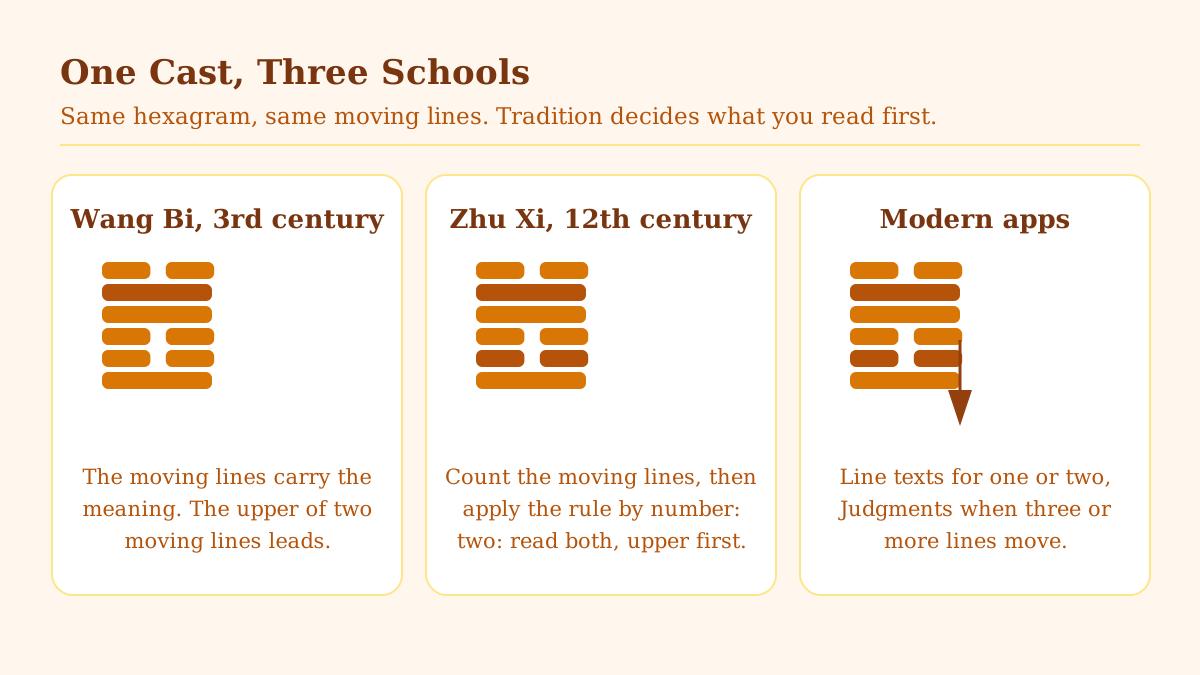
Notice what does not change between the rows. Nobody says skip the original hexagram. Nobody says ignore the moving lines. Nobody says read the derived hexagram first. The disagreements are about weight, not about order. That is the real architecture of the tradition: one shared reading order, several competing weighting systems. If you can keep the order fixed and pick one weighting system you trust, you are already reading more consistently than most people who have owned the book for years.
Read the Original or the Derived Hexagram?
This is the question every first-year reader asks, and the honest answer is not a choice. You read both, always, in order, and the count of moving lines decides which one carries the weight.
| Original hexagram (本卦) | Derived hexagram (变卦) | |
|---|---|---|
| Tells you | The situation as it stands, the frame | Where the situation is heading if the change completes |
| What to read in it | Judgment, then the moving line texts | Judgment only, under the common convention |
| Weight with two moving lines | Primary: the situation still holds, the lines refine it | Direction: the next chapter, not the current one |
| Weight with three moving lines | Still first, but no longer alone | Nearly equal: together the two Judgments are the answer |
The mechanical reason to lead with the original is simple. The moving lines are lines of the original hexagram. Their texts were written for that stack, those positions, that combination of solid and broken neighbors. The derived hexagram has no line texts of its own in the standard reading; it contributes its Judgment, the summary of the situation it points to. So the reading always starts in the first hexagram and ends in the second.
The human reason matters more. Think of it as a map and a route. The original hexagram is the map: the territory, the terrain, the roads that exist. The derived hexagram is the route: the direction you are actually heading given where the lines are moving. With one moving line, the map dominates and the route is a fine correction. With two, the map still holds, but the route is richer, and the two moving lines describe the two turns in it. With three, the road has so many turns that the route starts to look like new territory, and the two maps together become the only way to see it. The count is not a difficulty score. It is a measure of how much of the answer lives in the map and how much in the route.
Two Moving Lines: a Working System
Take the convention and make it mechanical, because mechanical steps are what keep you honest at 11pm with a decision pending.
- Read the Judgment of the original hexagram. This is the situation, the frame. Everything the lines say sits inside it.
- Read both moving line texts, bottom to top. The lower one is the earlier thread, the upper one the later thread.
- Let the upper of the two lines lead. When the two texts point in different directions, the upper line is further along in time, so it is the nearer instruction. The lower line is the prelude to it.
- Flip the two lines and read the Judgment of the derived hexagram. This is where the two threads converge.
- Write the whole thing as one sentence: the situation, the first thread, the second thread, the destination.
A worked example, using the cleanest cast in the book. You ask about a new venture, and you cast the Creative, Hexagram 1, six solid lines, with the first and second lines coming up old. The second line of the Creative is one of the most quoted in the text. James Legge's 1899 translation:
In the second line, undivided, (we see its subject as) the dragon appearing in the field. It will be advantageous to meet with the great man.
The lower moving line is the first line, the hidden dragon, not the time for active doing. The upper moving line is the one above: the dragon appearing in the field, meet the great man. The upper leads, so the near instruction is engagement, seeking the right allies, showing yourself. Flip the two bottom lines and the two yang lines become yin, and the Creative becomes Hexagram 26, Great Accumulating: the mountain holding the gathered strength.
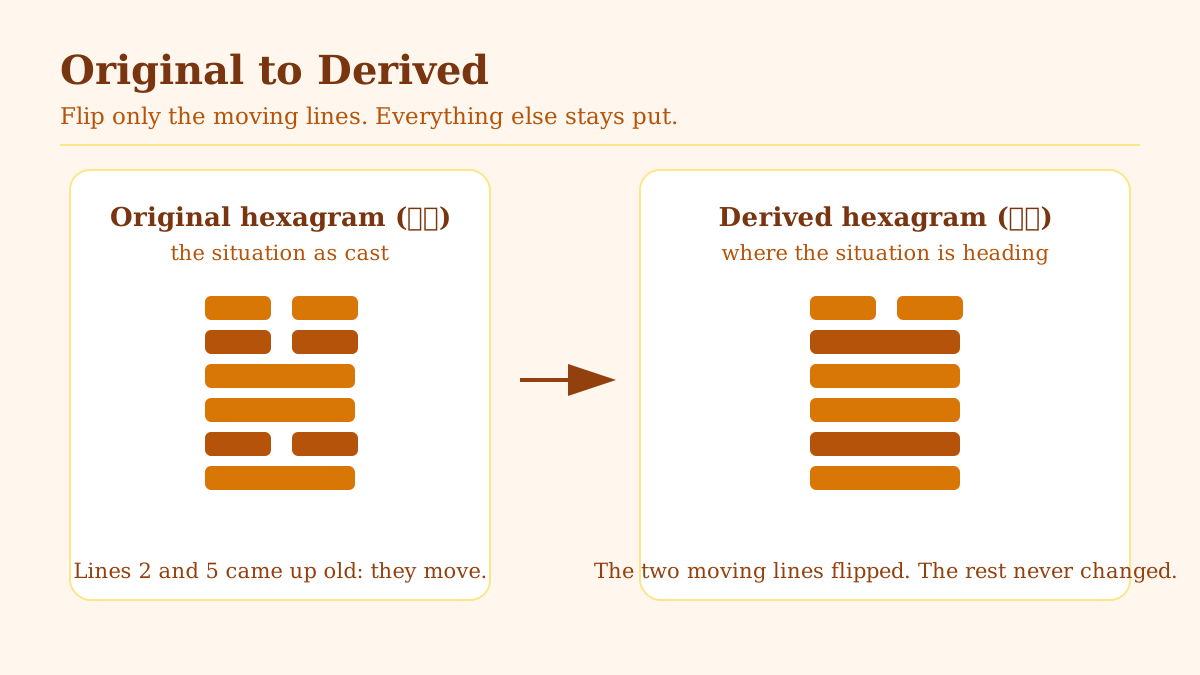
Read as one sentence: the venture has the full creative force behind it, but the two threads are beginnings, and the destination is a period of gathering, not a sprint. Everything you would normally do with a big idea, the preparation, the people, the stockpiling, is the actual work of this cast. The upper line tells you to go meet the great man. The derived hexagram tells you what the meeting is for. You can follow the whole arc at Hexagram 26.
Three Moving Lines: a Working System
Three moving lines is the pivot count: past it, the derived hexagram stops being a footnote. The system changes weight accordingly.
- Read the Judgment of the original hexagram first. This is still the situation you asked about; the frame does not dissolve.
- Read the Judgment of the derived hexagram next, before any lines. With three lines moving, the destination is half the answer.
- Read the three line texts, bottom to top, as the how. The lines describe the mechanics of the change, not its verdict.
- Weigh the pair of Judgments together: the original is the root, the derived is the fruit. If they seem to disagree, the derived is where the situation is going and the original is where it started.
- Draft the answer as two sentences: where the situation stands, and where it is heading. Let the lines argue the details.
The classic example is again the Creative, this time with the first, second, and third lines all moving. Same hexagram, same question, and the derived hexagram is Hexagram 11, Peace (泰): heaven below, earth above, the image of what was blocked beginning to flow. It is traditionally counted among the most auspicious texts in the book. The third line of the Creative, which Legge renders:
In the third line, undivided, (we see its subject as) the superior man active and vigilant all the day, and in the evening still careful and apprehensive. (The position is) dangerous, but there will be no mistake.
Three lines moving says the situation itself is turning, not just one thread of it. The Judgment of the Creative gives you the frame: the full creative force is present. The three line texts give you the how: the hidden beginning, the field where you meet the great man, the days of active vigilance. And the derived Judgment, Peace, gives you the fruit: the pressure converts to flow, what you have been forcing starts to carry itself. The instruction buried in the count is to stop gripping the outcome and keep doing the daily work carefully. The verdict is in the Judgments; the lines are the cost of admission. Read the destination in full at Hexagram 11.
When the Line Texts and the Judgment Seem to Disagree
Earlier I said the conflict is usually the reading, not an error. Now let me give you the actual way to work it, because "the conflict is the message" is only useful if you can say what the message is.
The Judgment speaks at the level of the situation: this is the kind of moment you are in, this is the character of the terrain. The line texts speak at the level of the exact position: this is the specific thing to do or not do, right now. When they pull apart, you are usually being told that the general shape of your situation (the Judgment) and the specific instruction (the line) operate on different timetables. The classic example is the Creative's own first line: the Judgment says strength and initiative, and the line says the dragon is hidden, not the time for active doing. Those do not contradict each other. The Judgment is about the power available to you. The line is about what to do with that power this week, which is to prepare, not to announce.
With two moving lines, the same logic handles the messy cases. If the upper line says go and the lower line says wait, you do not average them into a shrug. The upper line is nearer in time, so the sequence is: wait now, go next. If the lines both say wait and the Judgment says the opportunity favors you, you are being told that the opportunity is real and the timing is not yet. Timing is the axis of the entire system. Naming the axis is the point.
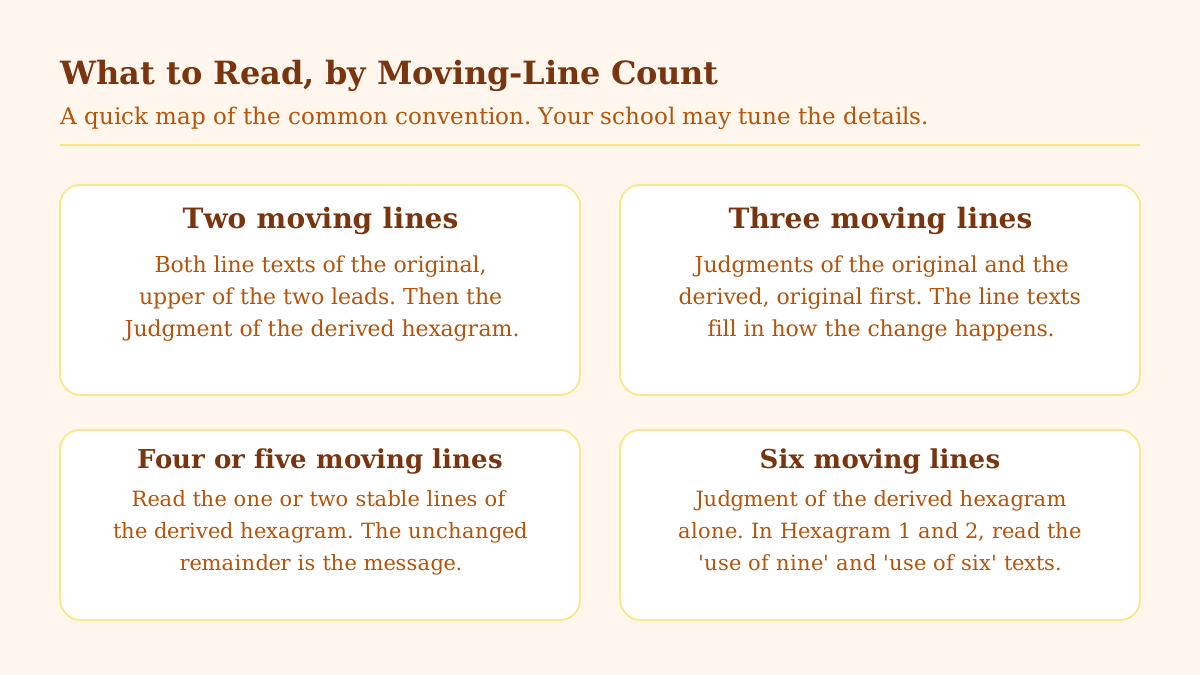
With three moving lines, the disagreement question mostly disappears, because the two Judgments outrank the lines. If the derived Judgment is auspicious and a line text is harsh, read the harshness as the cost of getting there, not as a veto. If the derived Judgment is rough and the lines are serene, the serenity is the process and the roughness is the terrain. The count tells you which layer to trust, and the layer rule is the same every time: one or two lines, trust the lines for specifics; three, trust the pair of Judgments; the single-line case and its conventions are covered in the changing lines explainer.
What Many Moving Lines Say About Your Situation
Strip out the mechanics for a second, and the count itself is information. A cast with two moving lines is a situation with two forces in motion, and the reading is about how they relate. A cast with three is a situation in which the very ground is reorganizing, and the reading is about direction more than position.
The line positions back this up. Traditional readers divide the six positions into three registers: lines 1 and 2 are the earth register, foundations and beginnings; lines 3 and 4 are the human register, the level of relationships and effort; lines 5 and 6 are the heaven register, the level of timing, leadership, and forces beyond your control. Two or three moving lines spread across registers says the change is happening on several levels at once, and your work is to notice which register is moving hardest. Lines moving low in the stack are about your own foundations. Lines moving high are about circumstances you can influence but not decide.
Two honest notes before you go novel-gazing with this. First, more movement is not more danger. A cast with three moving lines is not "worse" than a static one; it is a different shape of answer, a road instead of a map, as established above. Second, do not let the count override the texts. The technique exists to organize the reading, not to replace it. If the Judgments and lines are perfectly clear, the count is a footnote no matter how many lines moved.
FAQ
The upper of the two. Read both texts, bottom to top, and treat the upper one as the nearer instruction: it is further along in time, closer to the outcome. The lower line is the earlier thread, the prelude to the upper one. This is the convention in Zhu Xi's rule and in most English-language books.
Both, in that order, every time. The original hexagram is the situation as it stands, the derived hexagram is where it is heading. With two moving lines the original carries most of the weight; with three the two Judgments share it nearly equally. You never read the derived instead of the original.
None, but the reading changes shape. Four or five moving lines: read the one or two stable lines of the derived hexagram, because the unchanged remainder is the message. Six: read the derived Judgment alone, with the "use of nine" and "use of six" texts reserved for Hexagrams 1 and 2. The count never invalidates a cast; it only reallocates where the answer lives.
It means the situation itself is in transition, not just one thread of it. The standard reading is the Judgments of both hexagrams as a pair, original first: the original names where you are, the derived names where you are heading, and the three line texts describe how the change happens.
Often. With coins, two moving lines come up in 29.7% of casts, three in 13.2%, and the two together cover roughly 43% of everything you cast. A static hexagram, one in six casts, is the rarer outcome.