Hexagram 13: Fellowship — What It Means for Your Question
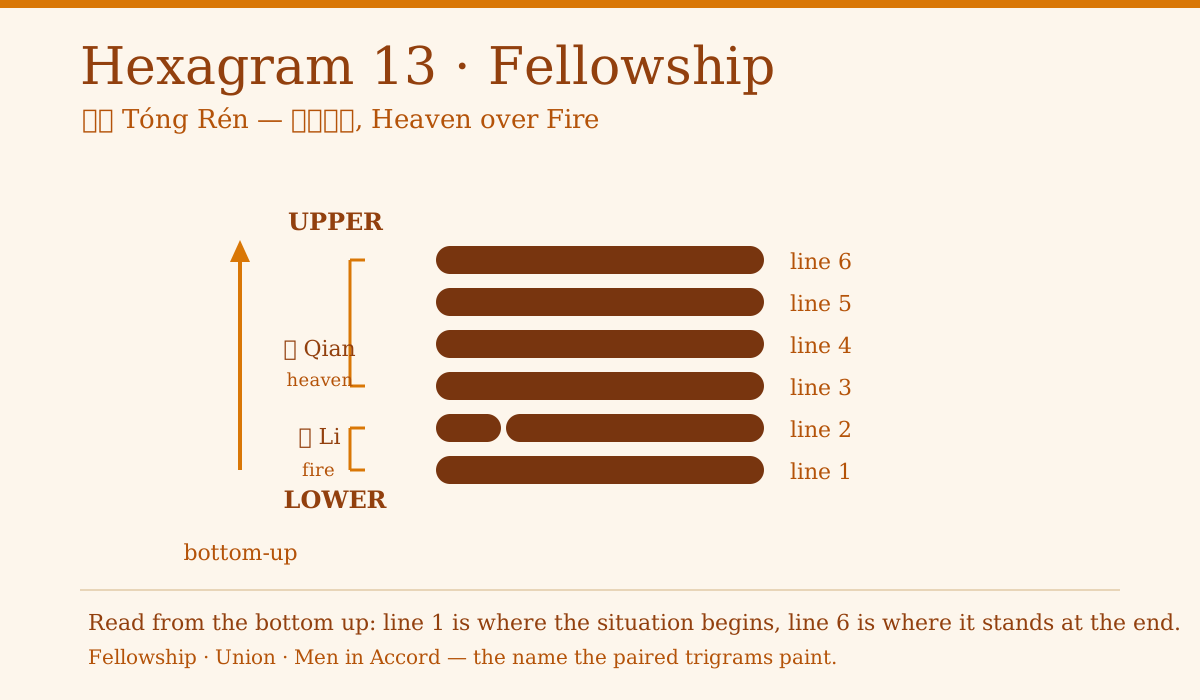
Hexagram 13, Fellowship (同人, Tóng Rén), is heaven over fire: your bright inner intention rising toward an open sky. Its Judgment says association in the open field brings success, and its instruction is to cross the great water — to take on the bold, public undertaking — with the constancy of a mature person. In practical terms, 13 is the hexagram of widening the circle: whatever your question, its answer leans the same direction, whether you win by bringing more people into the open, and its warnings are all about what happens when the circle closes instead.
- Hexagram 13 is Fellowship — 同人, Tóng Rén: heaven (☰) over fire (☲), light rising to meet the sky. It sits 13th in the King Wen sequence, between the standstill of Hexagram 12 and the great possession of Hexagram 14.
- The judgment says: associate in the open. Success comes from the open field, not the private circle; bold shared undertakings ("cross the great water") are favored — on condition of steady conduct.
- The famous warning is line 2: fellowship within the clan brings regret. The inner circle is where 13 curdles. The famous gift is line 5: after weeping, laughing — reconciliation after struggle.
- Ask your own question: cast a hexagram free and see whether Fellowship answers you.
Hexagram 13 at a Glance
| Fact | Hexagram 13 |
|---|---|
| Number / name | 13 — Fellowship (also Union, Men in Accord) |
| Chinese | 同人, Tóng Rén |
| Structure | Heaven over Fire — upper ☰ Qian, lower ☲ Li |
| Element pair | Metal over Fire |
| Tone | Opening, uniting, outward-facing |
| Judgment (paraphrase) | Fellowship in the open field: success. Favorable to cross the great water, favorable for the noble person's constancy. |
| In the sequence | No. 13 sits between No. 12 Standstill and No. 14 Great Possession — stagnation ends when people unite, and wealth follows union |
| Image (象) | Heaven with fire: the noble person sorts people by kind and distinguishes things by class |
The sequence placement is worth noticing before anything else. Hexagram 12, Standstill (否), is the whole sky pressed down and nothing passing between above and below; nothing moves, the court and the common roads are blocked. Then comes 13, and the pressure breaks because people find one another. After union comes Hexagram 14, Great Possession (大有): the same heaven over fire pairing, reversed — strength below, brightness above — holding everything you could want. The tradition reads that run as a sentence: standstill ends in fellowship, and fellowship produces great possession. If you drew 13, you are standing at the hinge of that sentence.
A hexagram read in the abstract is a map; read on your own question it becomes directions. The fastest way to meet Fellowship properly is to ask it something real.
Ask one clear question, and if 13 comes up, the app shows you the heaven and fire pair, marks any moving lines, and points you to the right line text. Start with how to interpret your reading if this is your first cast, so the sequence — name, judgment, moving lines, derived hexagram — is already muscle memory. Then widen the circle and ask the question you have been keeping in the clan.
Cast a free hexagramThe Shape: Heaven Over Fire
Split the hexagram in half and the picture does most of the reading for you.
The upper trigram, Qian 乾, heaven, is the outer field: the wide world outside, everything public, open, and above you — the sky every city shares, the circle no one can fence. The lower trigram, Li 离, fire, is your inner ground: brightness, clarity, intention — the light you carry into the field. Fire rises; so does everything honest about you. The whole hexagram is that motion: your inner light lifting toward a sky that receives it without a ceiling.
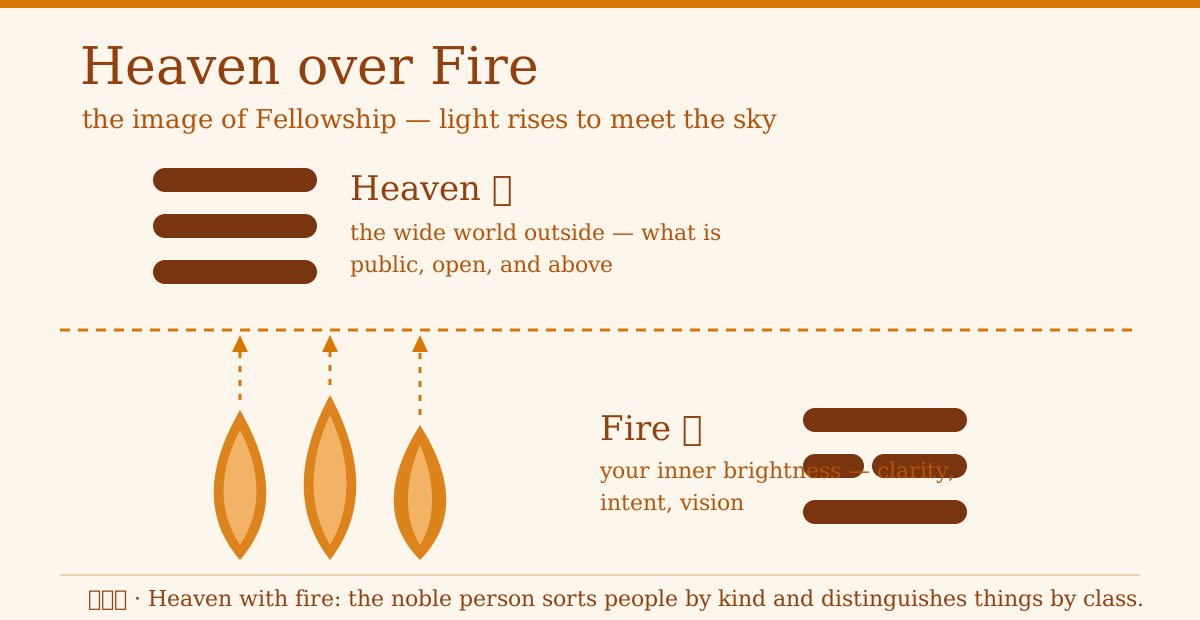
Now read the traditional Image text (象曰), which we verified against the classic text:
天与火,同人;君子以类族辨物。 Heaven with fire — the image of Fellowship. Thus the noble person sorts people by kind and distinguishes things by class.
That second clause is the part everyone skips, and it is the part that stops 13 from meaning "be friends with everyone." The sky above a fire does not swallow everything — it receives the light and lets each thing take its own place. Fellowship, in this reading, is not indiscriminate warmth; it is right grouping. The noble person's job is to distinguish kinds: who belongs in which circle, which task matches which person, what rises and what does not. 13 says the circles should be open — and that within them, placement must be honest. The fire sorts, the sky receives. That is the whole image.
The Judgment: Fellowship in the Open
The Judgment (卦辞) of Hexagram 13, from the classic text (verified against the Wikisource transcription of the Zhou text):
同人于野,亨。利涉大川,利君子贞。 Fellowship in the open field: success. Favorable to cross the great water, favorable for the noble person's constancy.
James Legge's 1899 rendering opens: "In (what is denoted by) Thung Žăn we have (the symbol of) fellowship with men in the open. (It indicates) progress and success; it will be advantageous to cross the great stream; it will be advantageous to maintain the firm correctness of the superior man." (Quote flagged for final verification at sacred-texts.com/ich/ic13.htm before publish.)
Three things in that Judgment do real work, and they are easy to miss because the sentence is short.
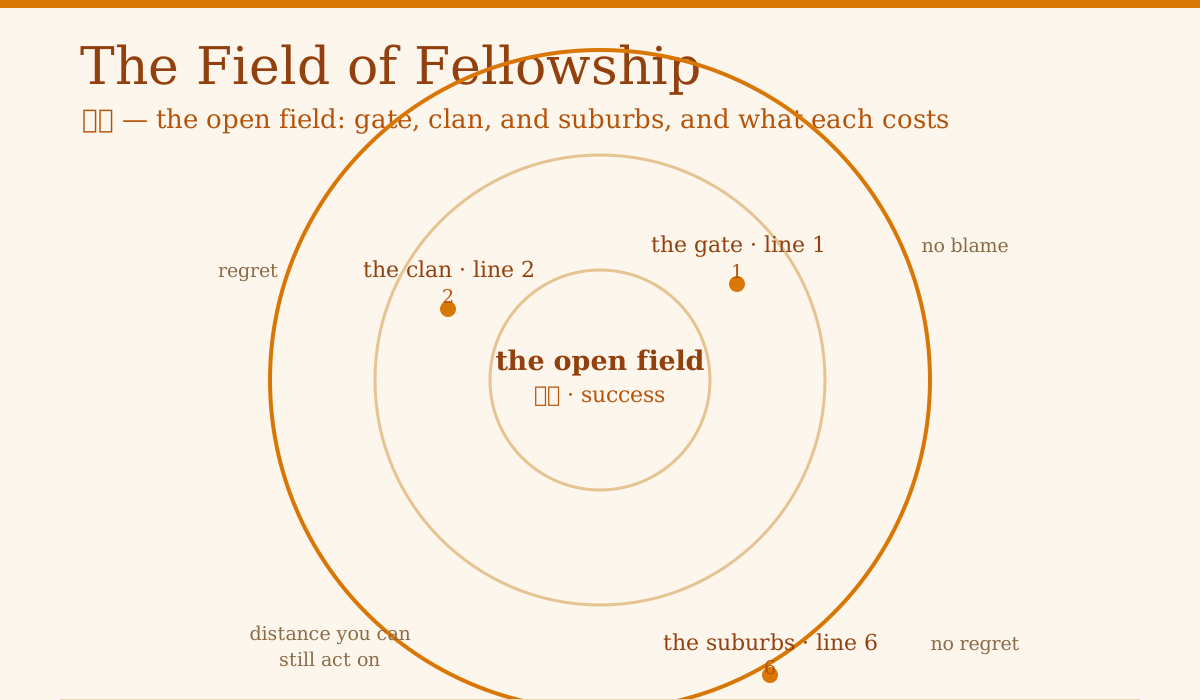
"In the open field" (于野) is a specific place, not a mood. The old texts contrast the field with the gate, the clan, and the suburbs — three other places fellowship can happen, each with its own price (line 1, 2, and 6 below walk through them). The field is the widest of all: no walls, no membership list, no shared surname. The Judgment is saying the widest circle is the winning one.
"Cross the great water" (涉大川) is the bold move clause. In the I Ching's stock vocabulary, the great water is the big, risky, public undertaking — the river crossing you cannot do alone and cannot undo halfway. Where other hexagrams warn you away from it, 13 says the water is favorable to cross because you are crossing it with people. This is the hexagram of the joint venture, the launch, the coalition.
"The noble person's constancy" (君子贞) is the condition. The success is not unconditional. The open fellowship only holds if the people in the field stay steady — the text's word is 贞, firm and correct — because an open circle has no wall to stop a bad actor from walking in. The condition is conduct, not vibes.
The Six Lines, One by One
Each line of Hexagram 13 reads a different distance from the center: the gate, the clan, the thicket, the wall, the field, the suburbs. Read in order, they form a map of how close or how far your fellowship stands.
| Line | 爻辞 (from the classic text) | What it means | If it moves |
|---|---|---|---|
| 6 (top, yang) | 同人于郊,无悔 | Fellowship in the suburbs: no regret. At the far edge of the circle, free of the inner-circle politics, you owe no one a faction — distance costs nothing here. | 49 Revolution — the far edge turns over; the change arrives and you ride it |
| 5 (yang) | 同人,先号咷而后笑,大师克相遇 | Fellowship that first weeps, then laughs; the great forces overcome and meet. The famous reconciliation line: conflict, tears, and then reunion after a real struggle. | 30 The Clinging — the weeping ends in clinging light; hold what is honest |
| 4 (yang) | 乘其墉,弗克攻,吉 | Mounted on the wall, yet does not attack: good fortune. You hold a position of advantage and choose not to strike — restraint that wins. | 37 The Family — the wall falls into the household; the fight turns into home business |
| 3 (yang) | 伏戎于莽,升其高陵,三岁不兴 | Arms hidden in the thicket, seen from the high ground, three years without rising. A hidden agenda, exposed before its time, accomplishes nothing. | 25 Innocence — the secret comes out; only plain dealing holds |
| 2 (yin) | 同人于宗,吝 | Fellowship within the clan: regret. Narrowing the circle to your own people is the one move the hexagram explicitly regrets. | 1 The Creative — the clan drops away and the field turns to pure sky; start over, openly |
| 1 (bottom, yang) | 同人于门,无咎 | Fellowship at the gate: no blame. Joining openly, at the threshold, asking nothing and hiding nothing — the right way in. | 33 Retreat — after the open start, the right move may be stepping back |
Line 1 — the gate, no blame. The gate is the boundary between private and public, and 1 says: meet people there. No favors owed before you walk in, no resume of loyalty, no clan papers to show. Open entry is the foundation; the hexagram's first word for it is 无咎, no blame.
Line 2 — the clan, regret. This is the line that catches most people when Fellowship shows up in a real question. 吝 is the text's word for regret — a small, sour cost, not a catastrophe — and it is the only line in the hexagram that pays it. Fellowship within the clan means: the friendship that would have worked in the open, kept inside the family, the department, the friend group, the couple that closes ranks against the world. The eagerness that would have united people now excludes them, and the joy leaks out. If you drew line 2, the reading is pointed: your circle is about to become the problem.
Line 3 — hidden weapons, wasted. and Line 4 — the wall, restrained. Lines 3 and 4 are the pair where fellowship meets rivalry. Line 3's man hides his weapons in the grass and climbs the ridge to spy, waits three years, launches nothing — the reading on the person who is playing politics inside an open circle; the secrecy itself is the failure. Line 4's man climbs the wall and does not attack: the person with a real position of strength who chooses restraint, 吉, good fortune. Read together: ambition is only strong if it comes out of the open; from the shadows it merely stalls, from the wall it can choose mercy.
Line 5 — weeping, then laughter. The heart-line of the hexagram, and the one people remember: 同人,先号咷而后笑 — fellowship that first wails, then laughs; and 大师克相遇, the great forces overcome and meet. The image is two parties fighting a long war, grieving in separation, and finally joining after the decisive struggle — tears first, reunion after. In a relationship reading this is the reconciliation line; in a business reading it is the merger after the hard negotiation. The key is the order: the laughter is not cheap. It is paid for by the struggle, and the text names both.
Line 6 — the suburbs, no regret. The farthest circle: 于郊, the outskirts, where the field ends and the wilderness begins. Here fellowship is thin — none of the heat of the inner circle — and the text says 无悔, no regret. There is a kind of right fellowship that happens precisely at the edge: the mentor at arm's length, the long-distance friendship, the person who helps from outside the drama. Distance in line 6 is not failure; it is a position.
Where Each Moving Line Leads
If one of your lines moved, flip it to its opposite and you get the derived hexagram — where Fellowship is heading if that line resolves. Here is where each of the six doors leads.
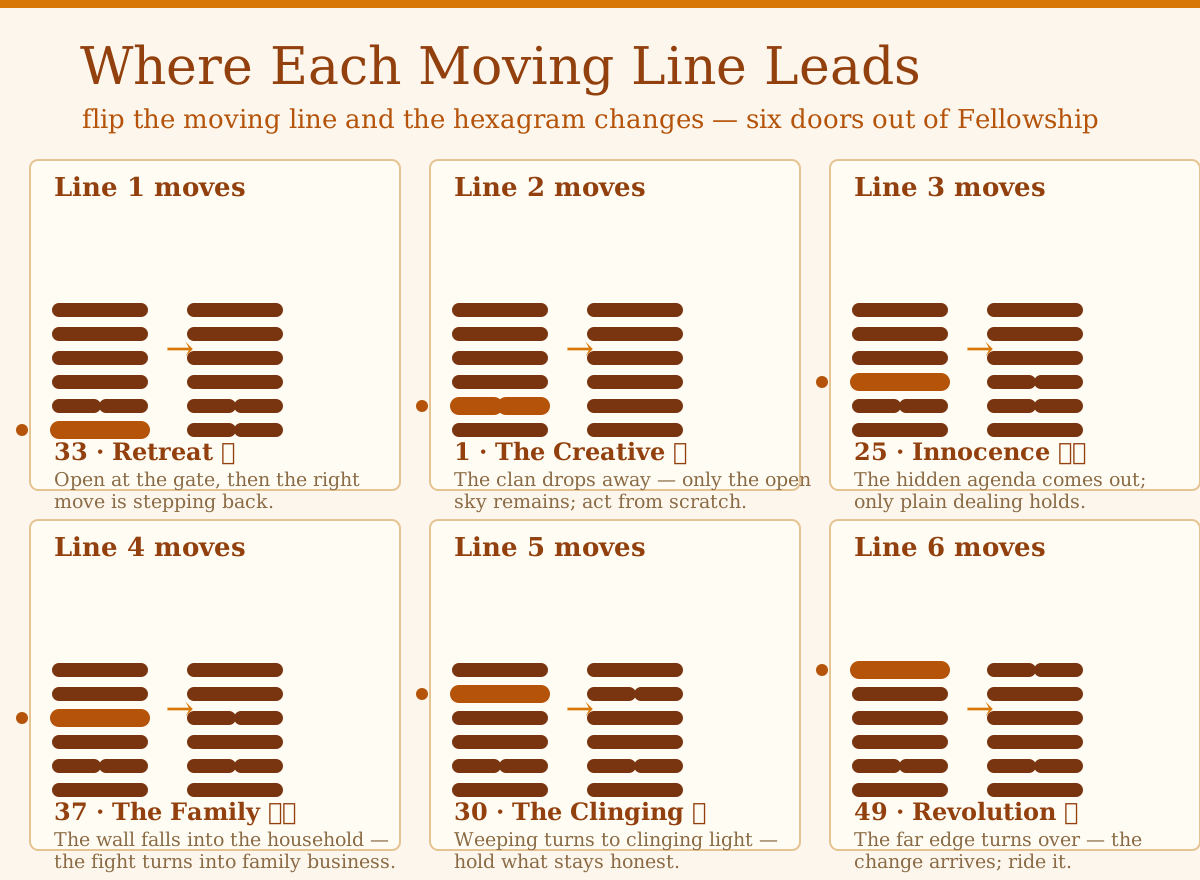
| Moving line | Derived hexagram | The shift |
|---|---|---|
| 1 | 33 Retreat (遁) | Open entry, then knowing when to step back — the retreat that is not defeat |
| 2 | 1 The Creative (乾) | The clan drops away and the whole field becomes pure sky — only an open, from-scratch start remains |
| 3 | 25 Innocence (无妄) | The hidden weapons are found; only straightforward conduct survives the exposure |
| 4 | 37 The Family (家人) | The wall falls into the household — the rivalry becomes family business; tend the bonds inside |
| 5 | 30 The Clinging (离) | The weeping ends in light; the reunion holds only while it stays attached to what is true |
| 6 | 49 Revolution (革) | The far edge turns over — change breaks in from outside; step off the wall and ride it |
Three of these are worth special note. Line 5 moving into Hexagram 30, The Clinging — fire over fire, light upon light — is the crown of the hexagram: the reconciliation that line 5 already promised, turned into doubled clarity. Read 30's Judgment as the destination of the weeping: the reunion is real, and it survives only while it stays attached to what it saw clearly in the struggle. Line 2 moving into The Creative is the surprise of the set: the clan closes, and instead of a punishment the field turns into pure heaven — the text hands the narrow circle one exit, and it is the brightest one: drop the exclusivity and start over in the open. Line 6 moving into Revolution says plainly what line 6 already hinted: the change you watched from the suburbs is arriving whether you step in or not, and the person who comes off the wall joins it instead of being knocked off it. If your cast has several moving lines, read each in turn and let the derived hexagrams build the sequence — the moving-line mechanics, including how many lines to weigh and how, are covered in how to interpret your reading.
Hexagram 13 for Love
Thirteen in a love reading is a weather system, not a decree, and its weather is: the wider you keep this relationship, the truer it stays. The hexagram's geometry is the point — your inner fire, rising into an open sky, nothing walled off.
- The circle test. Line 2's regret is the love reading's headline: a couple that closes its ranks — against friends, against honesty, against the world — pays 吝, a slow leak. If you drew line 2, ask what you two have stopped talking about with anyone else, or with each other. The clan is not safety; in 13 it is the one place that corrodes.
- The reconciliation line. Line 5 — first weeping, then laughter — is the reading for a relationship after conflict. The tears come first and they are the price of admission; the reunion is real, but only because the struggle happened. If you are in a fight with someone you love and drew line 5, the text says the laughter is on the far side of the struggle — go through it, not around it.
- The third-party warning. Line 3 — weapons hidden in the thicket — is the hexagram's alert about anything concealed in the middle of an open love: a secret, a rival, a half-told story. The text's verdict is that it stalls for three years and then accomplishes nothing; the secrecy is the only part that fails.
- The suburbs reading. Line 6 says the long-distance, the kept-light, the friendship that holds at arm's length is a legitimate shape of fellowship — 无悔, no regret. Not every loving bond needs to be pulled into the clan.
One honesty note, because love questions bring it up constantly: 13 leans favorable in the folk shorthand, and it genuinely is one of the warmer readings to draw — but how you phrase a love question changes the answer more than which hexagram you get. That art has its own guide here, the relationship guide, and its rules (ask about your conduct, not their feelings; one question, one cast) apply to Fellowship exactly as they do to every other hexagram.
Hexagram 13 for Work and Career
Work is where 13 shows its teeth, because work is where the open field actually exists. Careers are made of the same stuff as this hexagram: your light, other people's sky, and the question of how wide you keep the circle.
- "Cross the great water" is the career instruction. In a work reading, the Judgment's big river is the public undertaking — the project that crosses departments, the launch, the move that cannot be undone halfway. 13 says the water is favorable precisely because you are not crossing it alone. If your question is about the bold move, the answer leans: take the coalition, not the solo heroics.
- The gate opening (line 1). The right way into a team, a company, a market: openly, at the threshold, asking nothing and hiding nothing. 无咎 — no blame is the strongest praise line 1 can earn, and in career terms it means the entry that leaves no debt behind it.
- The wall without attack (line 4). Office advantage is a position, not a license. Line 4 wins by not firing: holding the high ground, letting the other side walk into the exposed position on their own. It is the hexagram's advice for the person who could win a fight and chooses the superior play: win the position, skip the war.
- The hidden-agenda colleague (line 3). The person maneuvering in the weeds — the secret pitch, the back-channel — receives the text's harshest verdict: three years of nothing. If you recognize your own project in line 3, the reading says come out of the thicket; the high ground only works in the open.
- From fellowship to possession. Remember the sequence: 13 produces 14, Great Possession — the wealth that follows union. The tradition reads 13 as the cause and 14 as the result. In career terms: secure the alliance first, and the holdings follow. Anyone who has built a team knows the order is not reversible.
Hexagram 13 for a Hard Decision
Fellowship as a decision-making tool has one move that no other hexagram teaches: it turns a private dilemma into a public one. The whole hexagram is a test you can run on any difficult choice.
- Name the circle. Every hard decision has an implicit circle — the people it affects, the people you would tell, the people currently excluded. Write the circle down. The hexagram asks: how wide is it, and is the width deliberate?
- Run the field test (于野). Would this decision survive the open? If you could explain it in the meeting, in the group chat, to a stranger — does it still look right? The Judgment says the answer is decided in the field, not in the family room. A choice that only makes sense inside the clan should be treated as already suspect.
- Watch for the two traps. Line 2's clan reflex: keeping the decision private because it protects your people — the regret line says that protection is what quietly ruins it. And line 3's thicket: the part of the plan you are not saying out loud yet. Both are the same disease in different rooms: the circle is closed, and 13 closes its verdict — open it.
- Choose like line 4. When you have the power to force the outcome and the discipline not to — that is the mature decision posture of this hexagram: 吉. The decision that has to be forced is usually the one line 4's restraint was made for.
- And after the decision, line 5. Expect the weeping before you see the laughter. A hard decision honestly made will cost something first — the fight, the goodbye, the apology — and 13 says that cost is the down payment on the reunion. Read the laughter as promised, not as overdue.
Two decisions 13 is not good for, so you can save a cast: decisions about other people's minds (the book reflects your conduct, not their hearts — the relationship guide spells out why) and verdict-hunting. If you drew 13 hoping for a flat yes or no, notice what you got instead: a description of the open field and the condition attached to it. The yes/no shorthand for the favorable hexagrams lives in the single-hexagram guide, and its rule for 13 matches what the Judgment says here — favorable on condition of steady conduct.
The Hexagrams Around Fellowship
Fellowship is a hinge, and knowing its neighbors and its destinations is how you read the whole neighborhood.
- 12 Standstill → 13 → 14 Great Possession. The run of the sequence: blocked, united, abundant. If your question is "where is this going," the sequence is the answer's shape — union first, plenty after. Hexagram 1, The Creative, supplies 13's upper half: the sky, the public field, the unceasing drive of what is above. Hexagram 2, The Receptive, is 13's temperamental opposite in the family sense — where 2 receives, 13 gathers — and reading the pair is a good way to test whether your situation is about support (2) or about alliance (13).
- The six doors: 33 Retreat (line 1), 1 The Creative (line 2), 25 Innocence (line 3), 37 The Family (line 4), 30 The Clinging (line 5), and 49 Revolution (line 6) — each a resolution one of 13's lines is walking toward. The two worth studying first are 30, because it is the "the weeping turns to light" door, and 49, because it is the "change arrives before you are ready" door.
- The trigram foundation. If you want to rebuild 13 from the ground up — why heaven over fire means fellowship and not something else, and how the same eight trigrams build all sixty-four hexagrams — the eight trigrams guide walks each symbol with its element, its family role, and the stacking rule. And of course, the full text and line-by-line notes for this hexagram live on the Hexagram 13 page — judgment, image, and all six lines in one place, plus a castable reading.
FAQ
It is one of the friendlier draws: fellowship in the open field, favorable to cross the great water, on condition of steady conduct. But "good" is the wrong frame — 13 is a situation, and its quality depends on whether you widen the circle (the Judgment's way) or let it close (the line 2 trap).
Open-heartedness: the relationship should widen, not close ranks. Its famous line 5 promises reconciliation after a real struggle — weeping first, laughter after. Line 2 warns that a couple that turns into a closed clan leaks the joy out of the bond.
In the I Ching's stock vocabulary it is the bold public undertaking — the river crossing you cannot make alone and cannot undo. In Hexagram 13 the great water is favorable because you are crossing it with allies; this is the hexagram of the joint venture, the launch, and the coalition.
Line 5, the ruler's line — fellowship that first weeps then laughs, the reconciliation after struggle, and the destination of the whole hexagram's movement. The one to watch for in your own cast is line 2, the clan, the only line the text explicitly regrets.
Hexagram 8 (比, Bi) is one center gathering followers around it — the magnet and the filings. Hexagram 13 is peers gathering in the open field — equals, not followers, held together by the width of the circle. Both are about union; 8 is union around a person, 13 is union in the open.