What Are the 8 Trigrams in the I Ching? (Bagua Meanings)
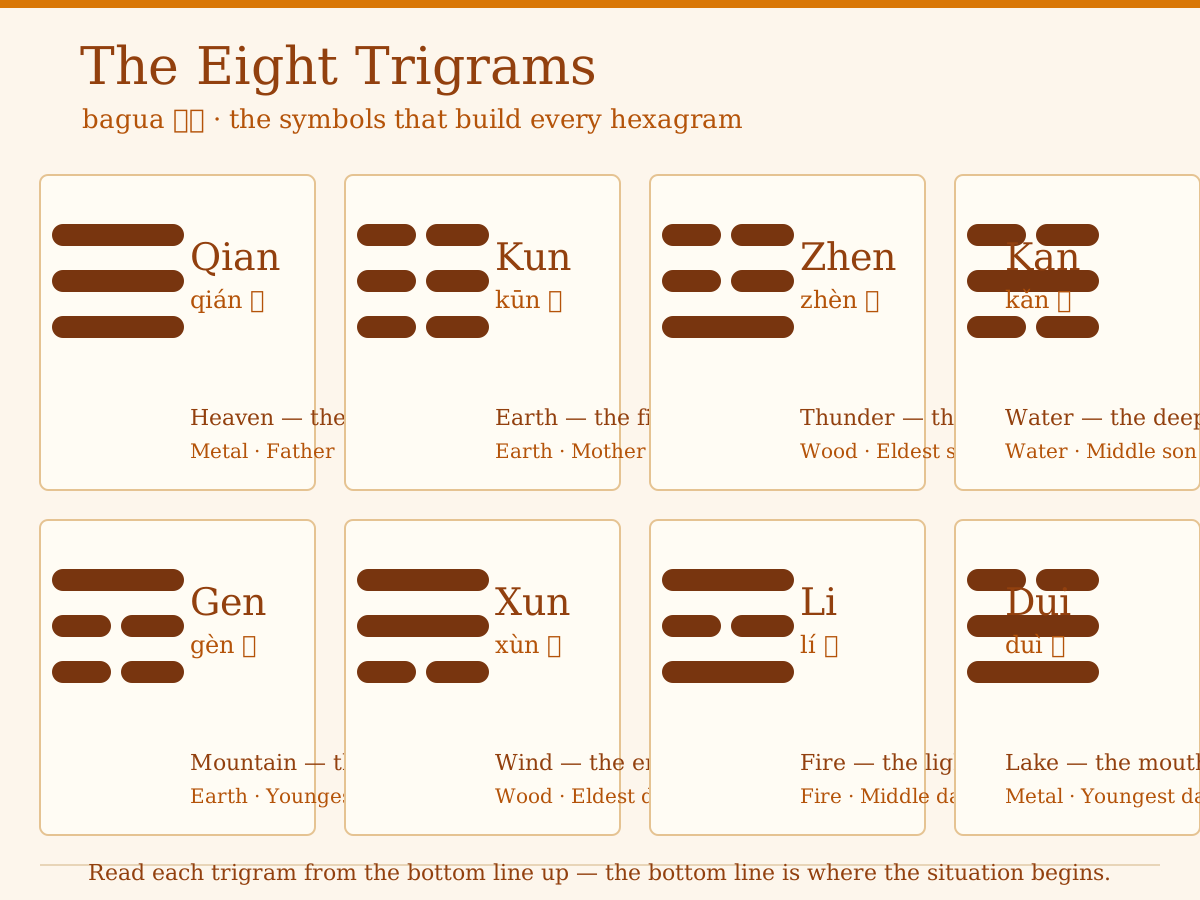
The eight trigrams are the alphabet of the I Ching. Each one is a stack of three lines — solid or broken — and each is named after a force of nature: heaven, earth, thunder, water, mountain, wind, fire, and lake. Taken alone, a trigram is a small picture of one kind of energy: the drive of heaven, the stillness of a mountain, the joy of a lake. Taken in pairs, two trigrams stack into one of the 64 hexagrams — so the whole book, every situation it describes, is built from just these eight symbols and the meanings the tradition attached to them.
- A trigram is three lines — solid (yang) or broken (yin) — and three lines make exactly eight possible figures. Each is named for a natural image: heaven, earth, thunder, water, mountain, wind, fire, lake.
- Every trigram carries attributes. The old commentaries give each one a character, a five element, and a family role — Qian is the father of the trigram household, Kun the mother, and the other six are their sons and daughters.
- Two trigrams make one hexagram. Stack any upper trigram on any lower trigram and you get one of 8 × 8 = 64 hexagrams. The hexagram's name is the picture the pair paints.
- Your question shapes the answer. Before you cast, see how to ask the I Ching a question — open vs. closed phrasing, with bad-to-good rewrites.
- Want to see the whole system in action? Cast a hexagram and the app tells you which two trigrams you got, free, in two minutes.
What Is a Trigram?
Every symbol in the I Ching is built from two kinds of line: solid, which the tradition calls yang, and broken, which it calls yin. Stack three lines and you get one of eight possible figures — two choices for the bottom line, two for the middle, two for the top: 2 × 2 × 2 = 8.
| Line type | Drawn as | Nature |
|---|---|---|
| Yang | ————— | solid, firm, active |
| Yin | — — | broken, yielding, receptive |
The eight figures are the trigrams (卦, guà), and they have been read from the bottom line upward for as long as the book has existed. The bottom line is where the situation begins; the middle line is its core; the top line is where it resolves. That bottom-up habit matters, because it decides how you read both a trigram and a hexagram.
A trigram is three lines; a hexagram is six. Six lines give 64 figures, which is the whole book. But the book did not start with 64 symbols — it started with the eight trigrams and the images they carry, and the hexagrams came from stacking them. Learn the eight, and the names of the 64 stop being arbitrary: every hexagram name is the two trigrams talking to each other.
The eight trigrams take ten minutes to learn and a lifetime to stop surprising you. The fastest way to lock them in is to meet them on your own cast.
Free, no account, two minutes. The app builds your hexagram from the bottom up, shows you your two trigrams, and marks any moving lines. Then flip back to the companion guide (Hexagram 13, Fellowship) to see a full trigram pair read line by line. And if you still prefer the feel of coins in your hand, our coins vs yarrow vs online guide shows you the tallying either way.
Cast your first hexagramThe Eight Trigrams at a Glance
Here are all eight, with the attributes the tradition attaches to each. The "character" column is a shorthand, not a horoscope — a trigram describes a kind of energy and the situations that energy produces, not a personality you are stuck with.
| Trigram | Symbol | Natural image | Character | Five element | Family role |
|---|---|---|---|---|---|
| Qian 乾 | ☰ | Heaven, the sky | Creative, strong, leading | Metal | Father |
| Kun 坤 | ☷ | Earth, the field | Receptive, supportive, enduring | Earth | Mother |
| Zhen 震 | ☳ | Thunder | Arousing, impulsive, awakening | Wood | Eldest son |
| Kan 坎 | ☵ | Water | Testing, deep, danger-laced | Water | Middle son |
| Gen 艮 | ☶ | Mountain | Still, patient, immovable | Earth | Youngest son |
| Xun 巽 | ☴ | Wind, wood | Gentle, penetrating, adaptive | Wood | Eldest daughter |
| Li 离 | ☲ | Fire | Clinging, bright, perceptive | Fire | Middle daughter |
| Dui 兑 | ☱ | Lake, marsh | Joyous, open, sociable | Metal | Youngest daughter |
Two quick notes before the walkthrough. First, the order above follows the classic listing in the Discussion of the Trigrams (说卦传, Shuo Gua), one of the Ten Wings commentaries that grew up around the core text — heaven and earth first, then the three sons, then the three daughters. Second, the five elements did not start out attached to the trigrams; that mapping belongs to a later, Han-dynasty layer of correlative thinking. It is useful shorthand and it fills in the roof of this table, but it is not the oldest stratum of the book.
Qian and Kun — The Parents
Qian 乾 is three solid lines: pure yang, nothing else. Its image is heaven — the sky as the old texts felt it, not a place but a motion: unceasing, above everything, always pressing upward and onward. Its character is the creative: initiative, will, the strength that starts things and carries them through. Qian shows up when the answer is acted, not waited for. Its hexagram, Hexagram 1, The Creative, is heaven over heaven — the purest reading of the book, and the image the tradition uses for the founding act, the beginning of any undertaking.
Kun 坤 is three broken lines: pure yin. Its image is earth — the field that receives seed, the ground that supports everything without pushing back. Its character is the receptive: support, patience, endurance, the strength of yielding. Kun is not weak. It is the strength that outlasts: Kun carries the whole crop, and in the old texts its horse is the docile one that never throws its rider. Its hexagram, Hexagram 2, The Receptive, is the famous partner of the Creative — where Qian says "start," Kun says "hold, receive, and let it ripen."
In the trigram family of the Ten Wings, Qian is the father and Kun is the mother, and every other trigram is one of their children. That is not sentimentality; it is structure, as the next two sections show.
The Three Sons — Thunder, Water, Mountain
Each of the three sons has exactly one yang line, and the position of that line gives the son his rank. The youngest son has his single yang line on top, the middle son has it in the middle, and the eldest son has it at the bottom. That is the whole rule, and the Discussion of the Trigrams states it the same way: the first line gives the eldest son, the second the middle, the third the youngest.
Zhen 震, thunder, is the eldest son. One yang line at the bottom, pushing up beneath two yin lines, and the image is a shockwave: thunder at the start of spring, the jolt that wakes what slept. Zhen is the alarm clock of the system. Its character is arousal — movement that begins suddenly and moves everything. A Zhen moment says: something is stirring under the surface, and the first crack is not the whole story.
Kan 坎, water, is the middle son. A yang line trapped between two yin lines, and the image is the river in its channel: the current runs through, but only between the banks that press it. Kan is the abysmal, the deep place. Its character is testing — danger that teaches, the repeated crossing that builds the crosser. Water in the I Ching is rarely clean; it is the flood and the well and the bottomless pool, and Kan says: you are in the depth now, so move with the current, not against it.
Gen 艮, mountain, is the youngest son. One yang line on top, and the image is everything below it coming to a stop — the mountain that sits and will not be moved. Gen's character is stillness, and stillness in the I Ching is an action, not an absence: knowing when to halt, when to hold the line, when an immovable "no" is the correct move. A Gen moment says: stop here. Nothing further is gained by pushing.
The Three Daughters — Wind, Fire, Lake
The daughters follow the same rule with the opposite line. Each has exactly one yin line, and its position gives the rank: first line, eldest daughter; second line, middle daughter; third line, youngest daughter.
Xun 巽, wind, is the eldest daughter. One yin line at the bottom, entering beneath two yang lines, and the image is the wind that gets inside everything: through the crack in the door, under the roof tile, around the corner of the argument. Xun's character is gentle penetration — the soft force that goes where force cannot, the insistence that never stops and therefore always arrives. In the old catalogues Xun is also wood: the root that finds the gap in the stone. A Xun moment says: push softly, and keep pushing.
Li 离, fire, is the middle daughter. A yin line held between two yang lines, and the image is the flame: brilliant in the middle, dependent on what it burns. Li's character is clinging — the brightness that only exists attached to something else. That is why the tradition reads Li as clarity, vision, perception: the light that lets you see, which is also the fire that consumes what it stands on. A Li moment says: you are lit up now — see clearly, and keep your eye on the fuel.
Dui 兑, lake, is the youngest daughter. One yin line on top of two yang lines, and the image is the open surface: the marsh that mirrors the sky, the mouth of the lake that receives and gives back. Dui's character is joy — but joy with a specific address, because the old texts gloss Dui as the mouth: speech, exchange, the pleasure of shared words. A Dui moment says: talk, laugh, connect — the joy is in the exchange itself.
The Five Elements Behind the Trigrams
The elements column in the table above is worth one section on its own, because it is the part of trigram lore people most often misremember. The standard mapping, as taught for centuries:
- Metal: Qian (heaven) and Dui (lake). Two very different faces of the same element — the forging, decisive strength of heaven and the bright, cutting edge of the lake's clarity.
- Wood: Zhen (thunder) and Xun (wind). Growth in two forms — the sudden burst of spring thunder and the slow, patient climb of wind through everything.
- Water: Kan alone, the abysmal depth that is water's only face.
- Fire: Li alone, the clinging light.
- Earth: Kun (earth) and Gen (mountain) — the yielding field and the unyielding peak, both earth, opposite in temperament.
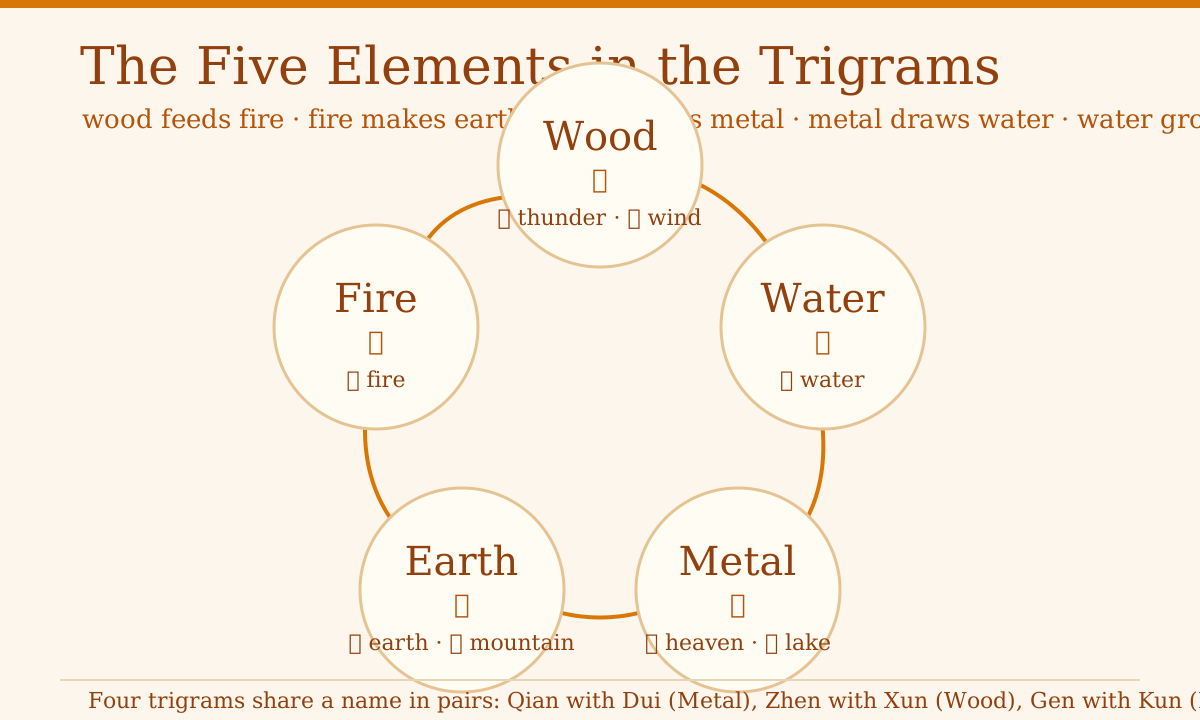
The generating cycle of the elements runs wood feeds fire, fire makes earth, earth yields metal, metal draws water, water grows wood — a closed wheel, and the trigrams ride it in pairs. How much should you lean on the elements when reading? Honestly: as a flavoring. In modern practice, people use the element pair of their two trigrams to get a quick read (metal over fire, say, being cutting clarity over burning intention), but the oldest reading tools in the book — the names, the images, the line texts — never mention elements at all. Use them like seasoning: they sharpen a reading, and they were added to the system later than everything else on this page.
Family Roles, Family Resemblances
The household reading of the trigrams deserves a closer look, because it is the fastest memory aid the system has. One father, one mother, three sons, three daughters — and each child's nature follows directly from how it was "born."
| Rank rule | Trigram | Family role | Nature in one word |
|---|---|---|---|
| One yang line, bottom | Zhen 震 | Eldest son | the jolt |
| One yang line, middle | Kan 坎 | Middle son | the depth |
| One yang line, top | Gen 艮 | Youngest son | the stop |
| One yin line, bottom | Xun 巽 | Eldest daughter | the entrance |
| One yin line, middle | Li 离 | Middle daughter | the light |
| One yin line, top | Dui 兑 | Youngest daughter | the joy |
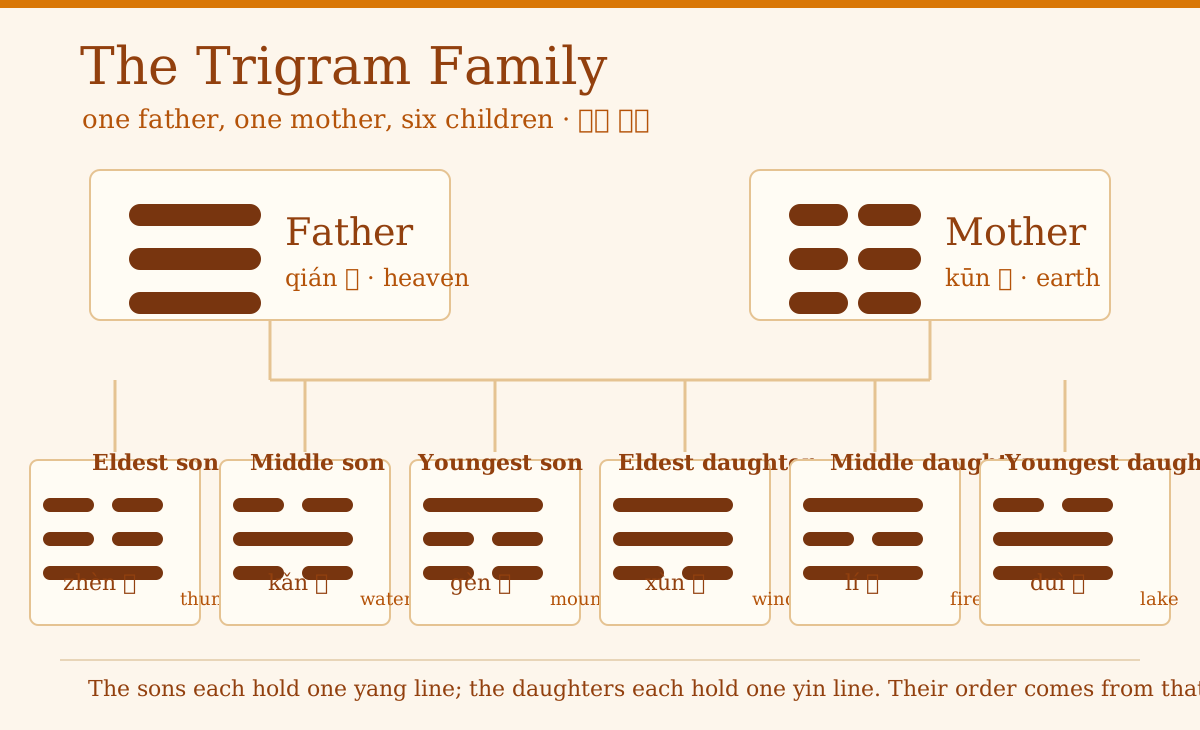
The sons are the trigrams with one yang line — the masculine forces inside a field of yin — and the daughters carry one yin line inside a field of yang. Their rank is not a verdict on their quality; the youngest son (mountain) is not "less than" the eldest (thunder), any more than in a real family. It is a position. A trigram's meaning is always read from its position: where the unusual line sits decides what the trigram is doing in that situation, not how important it is.
One honest caveat: when you read a hexagram, the family roles describe roles in a situation, not literal relatives. If line five of your hexagram is the father, it does not mean your father is involved; it means the situation has a "father" position — the one who sets the direction — and something is sitting there. Keep that and the family metaphor stays useful instead of turning into horoscope talk.
How Trigram Pairs Build the 64 Hexagrams
Here is the step that turns eight symbols into a whole book. Take any trigram as the upper figure and any trigram as the lower figure, stack them, and you get a six-line hexagram. Upper can be any of eight, lower any of eight — 8 × 8 = 64, and the 64 hexagrams are exactly that complete set. Nothing is missing, nothing repeated. The arrangement of the hexagrams in the King Wen sequence — the standard numbering, 1 through 64, used on every I Ching site including this one — is tradition's way of walking through those pairs.
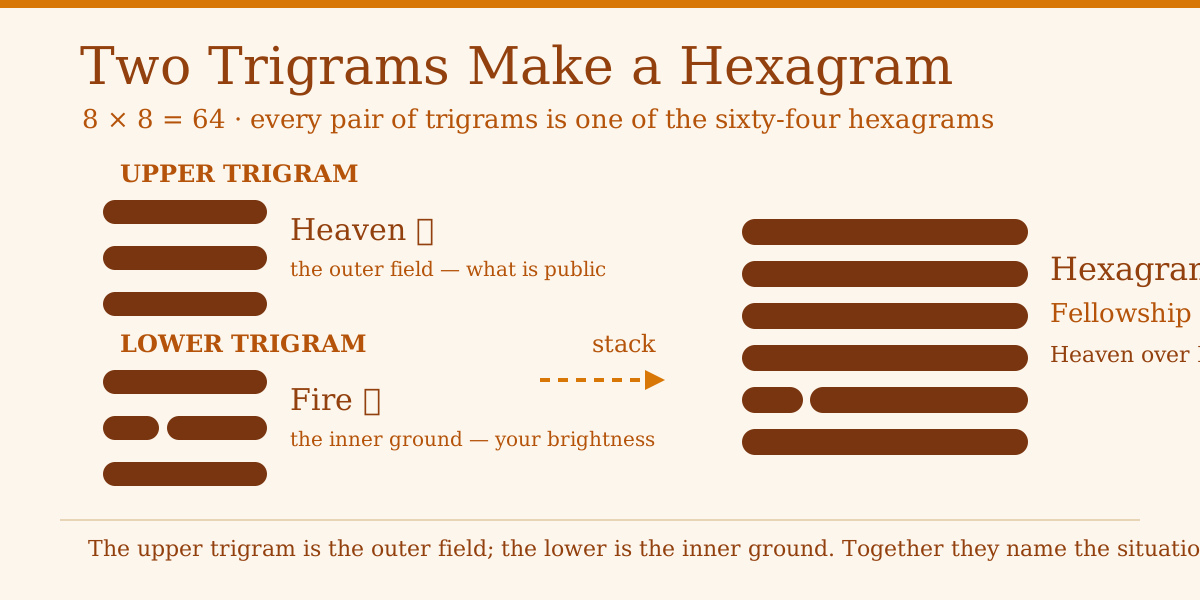
Some of the most famous hexagrams are the pure, self-stacking ones where a trigram meets itself:
| Upper trigram | Lower trigram | Hexagram | Meaning the pair paints |
|---|---|---|---|
| Qian ☰ | Qian ☰ | 1 — The Creative | heaven over heaven: pure, unbroken initiative |
| Kun ☷ | Kun ☷ | 2 — The Receptive | earth over earth: pure, responsive endurance |
| Qian ☰ | Li ☲ | 13 — Fellowship | heaven over fire: bright inner vision rising into the open world, light meeting sky |
| Li ☲ | Li ☲ | 30 — The Clinging | fire over fire: doubled clarity, sight depending on what it burns |
| Kan ☵ | Kan ☵ | 29 — The Abysmal | water over water: depth piled on depth, a test of falling and rising |
Every hexagram name is this kind of a two-trigram sentence. The name is rarely decorative: the tradition says the noble person reads a hexagram by splitting it in half and listening to what the two halves say to each other. Hexagram 13, Fellowship, is the worked example we use throughout this site — heaven above, fire below, the light of your intention rising to meet the open sky. You can read that whole reading in our companion guide to Hexagram 13, including all six lines.
Reading the Upper and Lower Trigram Together
Once you can split a hexagram into its two trigrams, you have the single most useful move in I Ching reading. The convention, followed by most modern teachers: the lower trigram is the inner ground — your state, your starting point, what you bring into the situation — and the upper trigram is the outer field — the world you are acting in, what is public, above, and given. Call it the situation's floor and its ceiling.
Worked example one: Hexagram 1, Heaven over Heaven. The floor is heaven and the ceiling is heaven. There is nothing below you and nothing above you but pure creative drive — which is why reading 1 is traditionally skipped over by beginners as "obviously good" when it is really a specific picture: a situation made entirely of initiative, with no ground to rest on and no limit pushing down.
Worked example two: Hexagram 63, After Completion, the famous near-final hexagram: water over fire. The inner ground is fire — burning intention, quick judgment — and the outer field is water — the flood that can quench it. The picture is a state of perfect order: the pot of water exactly over the flame, everything in its place, which is precisely as dangerous as it sounds. One tremor and the pot spills.
Worked example three: our Hexagram 13. Fire below, heaven above. Your inner brightness, rising toward a sky that accepts everything — the definition of open fellowship. The two trigrams agree: what you are, and what the world around you is, point the same direction. That is the structural reason 13 reads as union, and it is why the same pair read the opposite way (heaven below, fire above, in Hexagram 14) names wealth instead: the strength of heaven underneath, the light of your fire on top.
Here is the practical habit: before you read a single word of text, name your two trigrams out loud and say what each one is. "Lower fire — I am lit up and seeing clearly. Upper heaven — the field around me is open and boundless." Nine times out of ten, the situation has already told you its name before you open the Judgment.
The Bagua on the Compass
You will also meet the trigrams as a ring around the compass, most often in feng shui and in decorative bagua mirrors. That is the Later Heaven arrangement (文王八卦, wen wang bagua), named after King Wen, and it places each trigram at a direction:
- South, 离 Li — fire, brightness, summer, the full noon of the year
- North, 坎 Kan — water, depth, winter, the darkest quarter
- East, 震 Zhen — thunder, spring, the sunrise quarter
- West, 兑 Dui — lake, autumn, the harvest and the evening
- Southeast, 巽 Xun — wind, the gentle entering quarter
- Northeast, 艮 Gen — mountain, the quarter where the year turns
- Northwest, 乾 Qian — heaven, the father's quarter
- Southwest, 坤 Kun — earth, the mother's quarter
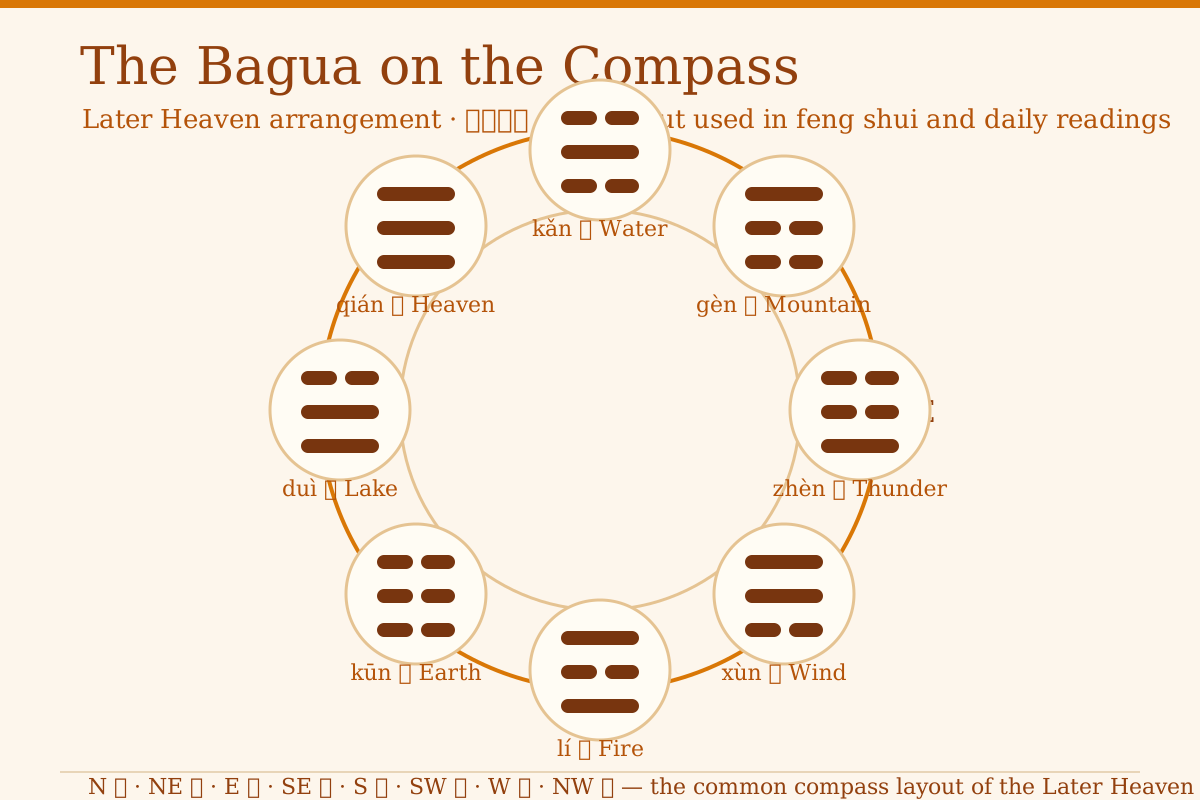
There is also an Earlier Heaven arrangement (伏羲八卦, fu xi bagua), the cosmic one, which places heaven and earth at the poles instead. Both are old, both are traditional, and for reading hexagrams neither matters much — the directions are ornamental. The one thing to remember from this section is the names: when someone says "the north trigram" or "the south trigram," they mean Water and Fire, the two elements that master the cold and the heat of the year.
One more layer is worth keeping, because it ties the ring to the calendar: the same Later Heaven ring carries the twelve Earthly Branches, so the trigram sectors line up with the Chinese zodiac years — the Rat in Kan due north, the Horse in Li due south, the Ox and the Tiger sharing Gen in the northeast.
FAQ
A trigram is three lines — one of eight figures — and a hexagram is six lines, or two trigrams stacked, one of 64 figures. A trigram gives you one kind of energy (heaven, fire, water); a hexagram gives you a complete situation, because it puts two energies in dialogue.
None of them. Qian (heaven) is the obvious candidate, but the book does not rank its trigrams — it places them. In a reading, the mountain's stillness and the wind's persistence carry exactly as much weight as heaven's drive, because what matters is what the situation needs.
As a flavoring, yes; as a judge, no. The element mapping (Qian and Dui are Metal, Zhen and Xun are Wood, and so on) comes from a later layer of the tradition than the core text. Use it to sharpen a reading — metal over fire feels different from earth over water — but let the names and images carry the weight.
Split your six lines in half. The bottom three are the lower trigram, the top three are the upper trigram, and each maps to one of the eight figures. Then read the lower as your inner ground and the upper as your outer field. We walk the step-by-step in how to interpret your reading.
Bagua (八卦) is Chinese for "eight symbols": ba means eight and gua means symbol or figure. It is the traditional Chinese name for the eight trigrams themselves. Western I Ching books usually say "the eight trigrams"; Chinese sources, feng shui manuals, and compass diagrams say bagua, and older romanizations sometimes spell it pakua. Same eight figures, same meanings, different name.
Yes. The bagua and the eight trigrams are one set of eight three-line figures under two names. When the word shows up on a bagua mirror or a compass ring, it is still the same eight symbols, arranged by direction in the Later Heaven and Earlier Heaven orders described above. The names multiply but the figures do not: learn the eight and you can read any bagua diagram. Stack any two of them and you get one of the 64 hexagrams; you can browse every pairing in the full hexagrams list.