I Ching Yes or No: When a Single Hexagram Answers
"Is it a yes or a no?" is the most common thing a new I Ching user wants from a cast — and the most hotly debated question in the whole modern reading community. Traditionalists say the book never answers yes or no, because it describes situations instead of issuing verdicts. Practical readers point out that the ancient text is packed with judgment words — success, advantage, good fortune, misfortune, danger, regret — and that a single clean hexagram can lean hard in one direction. Both sides are right, in the way both sides usually are. This guide explains the debate honestly, then teaches the one method that actually works when you need a lean answer: the single-hexagram direct read.
- The classic text issues no mechanical yes/no, but its Judgment words (亨 success, 利 advantage, 吉 fortune, 凶 misfortune) clearly lean.
- The single-hexagram direct method: close your question into one clause, cast once, and read the lean — favorable via the Judgment, refined by any moving lines.
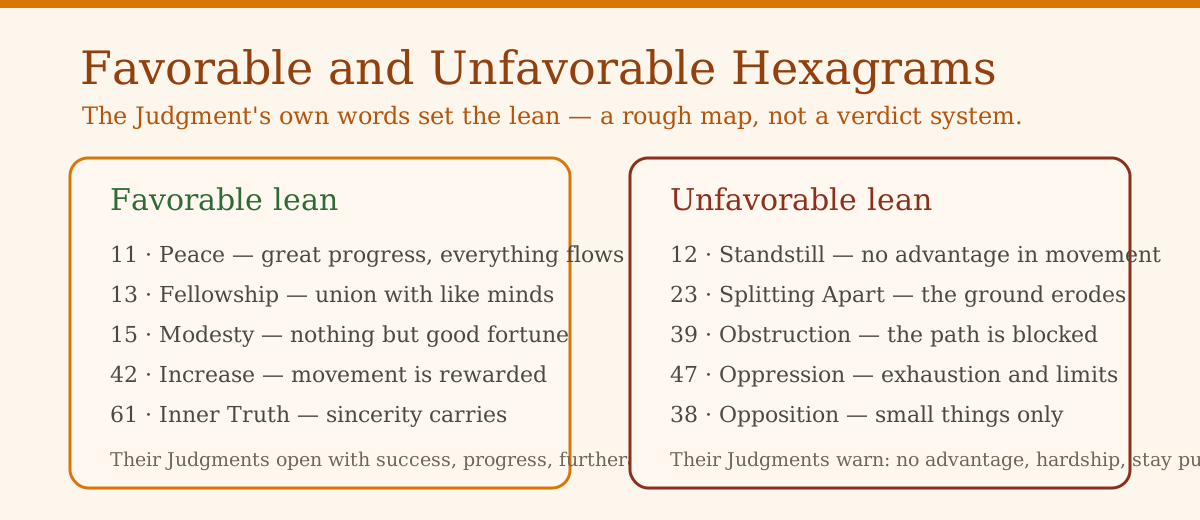
- Favorable-leaning hexagrams like 11 Peace (泰), 13 Fellowship (同人), 15 Modesty (谦) and 42 Increase (益) support a yes; unfavorable-leaning ones like 12 Standstill (否) and 23 Splitting Apart (剥) support a no or "not yet."
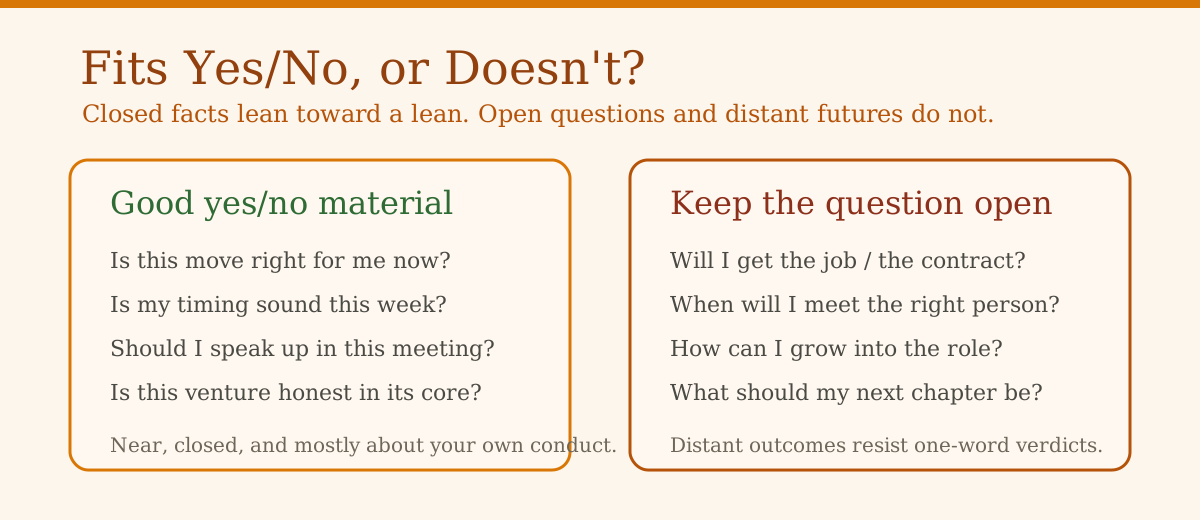
- Yes/no works best on near, closed, self-contained questions — and poorly on distant outcomes, timing questions, and anyone else's feelings.
- Ask once. The classic rule against repeated asking is the oldest instruction in the book on how to use it.
The Old Debate: Does the I Ching Answer Yes or No?
Walk into any two I Ching groups online and you will find this argument on repeat. The traditionalist position, associated with the great German translator Richard Wilhelm and most academic commentators, runs like this: the I Ching is a book of wisdom, not a fortune-telling device. It does not predict outcomes; it illuminates situations. Ask it "will I get the job" and it will politely hand you a description of your pursuit of that job — the energy, the obstacle, the correct timing — and leave the conclusion to you. Forcing a hexagram into a yes/no box, the traditionalists say, wastes the book's real faculty, which is showing you the shape of a situation rather than the outcome.
The practical position is shorter and comes from people who cast for a living. Nonsense, they say — the text is full of verdict words. Open the Judgment of any hexagram and you will find 亨 (success), 利 (advantage), 吉 (good fortune), and just as often 凶 (misfortune), 厉 (danger), and 吝 (regret). Those words are evaluations. The oracle was used for centuries to answer exactly the kind of yes/no questions that mattered to a king: will this campaign succeed, is this alliance sound, should I proceed? And the folk traditions that grew out of the book — the "six lines" school of reading, which is the lineage most Chinese fortune-tellers actually practice — built elaborate machinery precisely for deciding favorable and unfavorable from a cast.
Both positions survive because both are true at different levels. The classic text (the Judgments and line statements) describes situations and rarely delivers bare verdicts; anyone who tells you "Hexagram 51 always means yes" is selling something. But the tradition around the text — centuries of commentary plus the folk divination schools — absolutely developed ways to extract a yes/no lean, and those ways are coherent and useful. The honest frame is: the I Ching does not hand out verdicts by default, but it can be asked for a lean, and a lean is the most you should want anyway, because a lean is what a real decision needs.
You now have the whole honest toolkit: the lean direction, the Judgment markers, the moving-line tiebreaker, and the rule on asking once. What remains is a question worth closing and two minutes of coins.
Close your question into one clause, toss, and the app will mark your moving lines, build the derived hexagram, and walk you through the lean in plain English. If this is your first full reading, spend ten minutes on how to interpret your reading first, so the lean has the whole situation underneath it.
Cast a free hexagramTwo Schools, One Book
Here is the debate compressed into the two operating styles you will actually meet in books, apps, and forums.
| Traditionalist reading | Direct (yes/no) reading | |
|---|---|---|
| What the hexagram is | A description of a situation and its flow | An evaluation with a tilt |
| The question it wants | Open: "How should I…", "What is going on here?" | Closed: "Should I…?", "Is this sound?" |
| The answer it gives | A picture to think with | A lean: favorable, unfavorable, mixed |
| Moving lines | The nuances of the situation | The deciding vote, especially one line |
| The derived hexagram | Where the situation is heading | The outcome tendency, if nothing changes |
| Risk | Answer feels too vague to act on | Answer feels too cut-and-dried to trust |
The two schools do not actually fight about the mechanics — both read the same hexagram, the same lines, the same derived hexagram. They fight about the last step: whether you are allowed to convert the picture into a yes or no. The direct school's answer, which this guide shares, is that you are allowed to lean — as long as you remember it is a lean, not a decree. A lean is a conclusion with a paragraph of conditions attached. That is exactly the level of certainty a good decision needs, and it is the most the I Ching honestly offers.
How a Single Hexagram Leans: Reading Favorable and Unfavorable
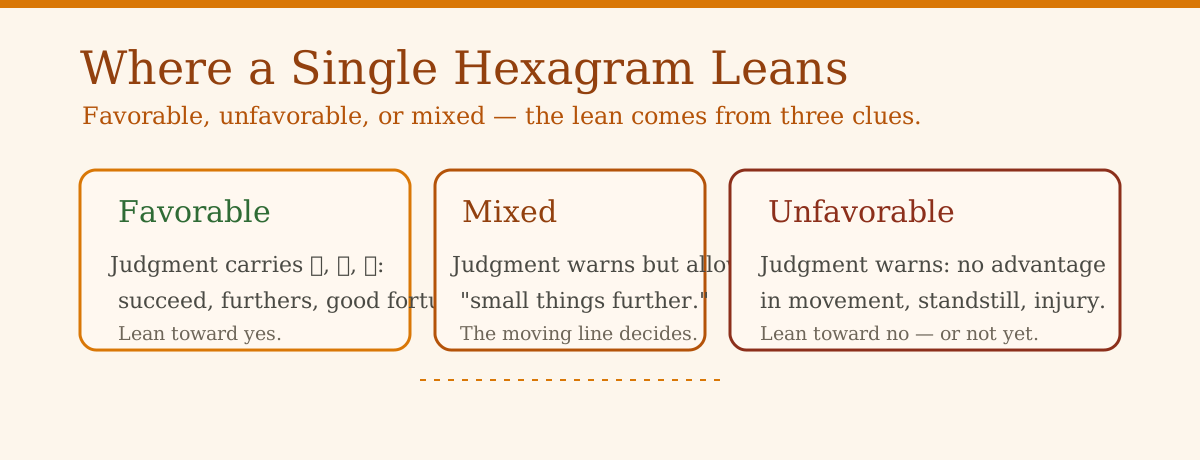
When you read a cast for a lean, the Judgment is the first witness. Its opening words matter most: the classical translators render the characteristic Judgment markers consistently, and those markers are your weather flags.
| Judgment marker | Traditional rendering | Lean |
|---|---|---|
| 吉 / 大吉 | good fortune / great good fortune | Strongly favorable |
| 亨 | success, penetrating | Favorable — things go through |
| 利 / 利有攸往 | advantage / it furthers to undertake something | Favorable — movement rewarded |
| 贞 | perseverance, correct | Favorable on condition — only with steady conduct |
| 无咎 | no blame | Neutral-leaning — safe but not triumphant |
| 悔 / 吝 | repentance / regret | Caution — small losses ahead |
| 厉 | danger | Unfavorable — tread carefully |
| 凶 / 无攸利 | misfortune / nothing furthers | Strongly unfavorable |
Read down that table and you already have a crude thermometer. The richer read comes from combining the marker with the hexagram's name and image, which is where the whole system earns its reputation. To give you a working map, here are the hexagrams that lean hardest in each direction — the ones you will memorize first and the ones the direct method leans on most.
| Lean | Hexagrams | What their Judgments say |
|---|---|---|
| Favorable | 11 Peace (泰), 13 Fellowship (同人), 15 Modesty (谦), 42 Increase (益), 61 Inner Truth (中孚), 53 Gradual (渐) | Success, great progress, union with like minds, every move furthers — the classic "good winds" cast |
| Unfavorable | 12 Standstill (否), 23 Splitting Apart (剥), 39 Obstruction (蹇), 47 Oppression (困), 38 Opposition (睽) | No advantage in movement, the ground erodes, the road is blocked, only small things go well |
| Conditional | 63 Completion (既济), 29 The Abysmal (坎), 17 Following (随), 33 Retreat (遁) | Good fortune at first, or good fortune if you behave a certain way — the "yes, but keep the terms" cast |
Two cautions before you use this table as a verdict machine. First, these are leans, not classes: Peace leaning yes does not make its answer unconditional, and Oppression leaning no can still carry a moving line that says "one honest conversation turns this." Second, the same hexagram leans differently under different questions — the Judgment is a description of a situation, and the situation shifts with what you ask. The table is a map, not a jail. For a full walk through the two poles, our Hexagram 11 and Hexagram 12 pages — Peace and Standstill, the famous pair — show how opposite judgments work close up.
The Single-Hexagram Direct Method
Now the method itself. It is three steps, and the first one does most of the work.
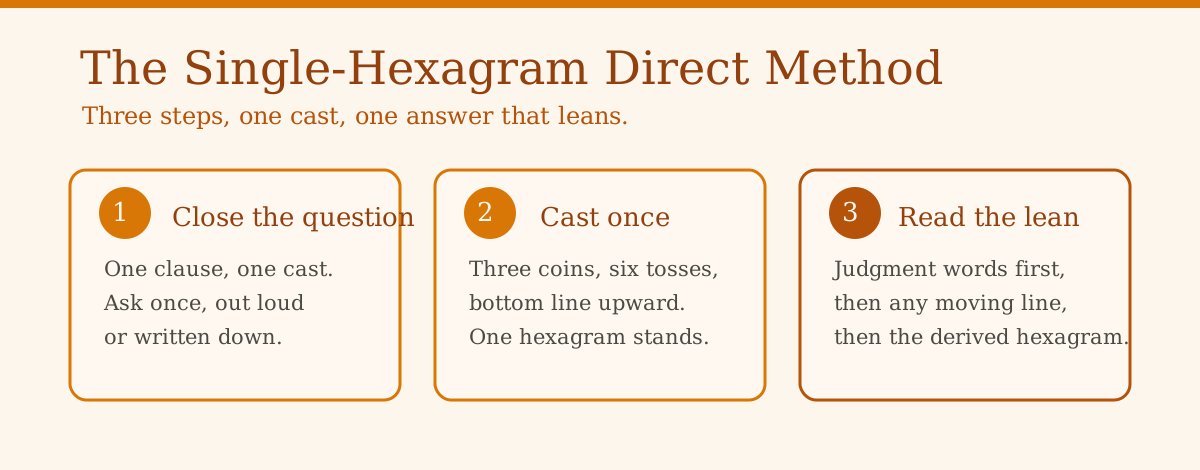
Step 1 — close the question. Write your question as one clause that can carry a yes or no. "Should I accept the counteroffer?" works. "What should I do about the job situation?" does not — that is an open question wearing a suit, and an open question gets an open answer. If you catch yourself writing "how," "what," or "when," you have left the yes/no lane; either close it ("Is this move wise?") or decide the direct method is not the right tool for this question (more on that below). One clause, one cast.
Step 2 — cast once, clean. Three coins, six tosses, bottom line upward, one hexagram. The full tallying mechanics are in our coins vs yarrow vs online guide, but the short version is: each toss gives you a line type, and your cast is complete in about two minutes. Cast sober, cast unhurried, and cast once. The I Ching's oldest instruction to askers — from Hexagram 4's Judgment, paraphrased — is that the first sincere ask gets answered and repeated importuning is refused. Treat the first cast as the only cast.
Step 3 — read the lean, in this order. First, name the hexagram and feel its image — Peace breathes different from Standstill, and you should feel that before you touch a table. Second, read the Judgment marker words from the table above. Third, read any moving line that appears: in the direct method, a moving line acts like a judge's note on the verdict — one solid moving line can pull an entire unfavorable Judgment toward "but this one step is safe," and one uneasy line can pull an entire favorable Judgment toward "not while this is unresolved." Fourth, flip the moving lines and glance at the derived hexagram; it is the tendency of the outcome if nothing changes, which is the closest the direct method gets to a forecast. Then state your lean out loud in one sentence, with its condition attached: "Yes — provided I do not rush the signing." That sentence is your answer.
A note on what the method is not. It is a modern simplification, a working convention for people who need a lean — it is not a sacred protocol handed down from the Zhou court, and the folk "six lines" school the fortune-tellers use is a far more elaborate system with its own rules for judgment. If you want the full folk machinery, learn it from a teacher; this guide is the honest, two-minute version that actually serves most everyday decisions.
A worked example keeps all of this concrete. Say you ask "should I accept the counteroffer?" and cast Hexagram 42, Increase (益): a favorable name, a Judgment that opens by praising "it furthers to undertake something" — that is a yes lean on its own. But the fifth line comes up moving, and its classic text praises the sincere heart and names its reward — the honest approach is what turns the gain real, the old commentaries say, and asking for confirmation is barely needed when the motive is clean. Your lean becomes: "Yes, with one condition — the path must stay honest, and the moment I would have to deceive to take it, the yes expires." The weakened absolute is the point of the whole exercise: the hexagram did not negotiate itself into a corner, it handed you a yes with its price tag attached. Without the moving line, you would have read either "take it" or "be careful" — with it, you got the actual decision.
Which Questions Fit Yes/No — and Which Don't
The direct method is a precision tool, and like every precision tool it has a proper workpiece. The shape of the question decides whether the answer will be clean or noisy.
| Fits the format | Fights the format |
|---|---|
| "Should I take this apartment?" | "Will I ever own a home?" — too far out, too many variables |
| "Is this the right week to launch?" | "When is the right week?" — dates are the text's weakest subject |
| "Should I raise the issue with my boss now?" | "How should I raise it?" — that is a how question; ask it open |
| "Is this partnership structurally sound?" | "Is this partner loyal forever?" — forever is not the book's unit |
| "Should I accept the offer?" | "Which offer should I accept?" — two casts, one question, against the rules |
| "Is now the time to speak in this meeting?" | "Will the client like my idea?" — another mind again; the book reflects yours |
Two patterns separate the columns. First, near beats far: the method reads situations that are currently in motion — this week, this decision, this month. Point it at a five-year horizon and it has nothing to grip; the judgment will describe the present state of your five-year goal, which you will then misread as a forecast. Second, me beats them: the I Ching reflects your conduct and your situation, not your rival's mind or your partner's heart. Ask it about another person's feelings and it will describe your own state wearing that person's name — which is why love questions get their own separate discipline (see our guide to asking about relationships, which covers exactly which love questions can and cannot be closed).
When to Stay Open Instead
Knowing when not to use the direct method will save you more confusion than learning any table. Keep the question open in four situations:
1. When the decision is a fork, not a yes/no. "Should I take the job?" hides a real fork (job A, stay put, job B, next year). A single hexagram cannot arbitrate between options; it can only lean on the course you named. If you are genuinely torn between two directions, cast each in its own one-clause question — or better, cast the open question "what should I understand before choosing?" and let the text sketch the field.
2. When the real question is "how" or "what." Growth questions — "how do I become more patient," "what am I not seeing" — are the book's best material, and shrinking them into yes/no wastes that material. The direct method trades depth for a lean; make sure you are getting something worth trading for.
3. When the outcome is distant. The text describes the present configuration of forces. "Will we be together in five years" is not a configuration yet; it is a hope wearing a calendar. Near, the book speaks; far, it hums.
4. When the question concerns someone else's mind. Loyalty, love, regret, intention — none of these are inspectable through coins. The reading you get will be a mirror, and a mirror pointed at your suspicion shows your suspicion, not their heart.
In all four cases, the correct move is the same: ask the open form, read the full situation, and let the lean emerge on its own instead of demanding it up front. Most of the time, when you finish describing the situation in your own words, the lean is already obvious — which was the point all along.
Asking Twice: The One Rule the Book Does Give
Every other rule in this guide is a modern convention with ancient support. This one is ancient support with no modern conflict: do not re-ask the same question because you did not like the answer.
The Judgment of Hexagram 4, Youthful Folly (蒙), which is the book's own passage about asking and learning, warns that the first sincere ask is answered, while a second and third importunate ask goes unanswered. Every later tradition keeps the warning in some form — the Wilhelm commentary calls double-questioning the death of the consultation; practicing readers learn it as "the second cast is the answer's bodyguard, not its replacement."
What this means practically for yes/no work: one question, one cast, one answer. If you re-cast "should I take the offer" because Peace felt too good to trust, you are not doing research — you are bargaining, and the bargain is refused. If a reading genuinely confused you, wait a day and re-read the same cast before you re-cast it; the confusion is usually in your reading, not the coins. And if you must cast again, change the question — that is how a stretched answer stretches: "Should I proceed?" followed by "what is the risk in proceeding?" is a consultation; the same question twice is begging.
FAQ
It leans rather than decrees. The classic text describes situations in evaluative language — success, advantage, good fortune, misfortune — and the single-hexagram direct method converts that language into a workable lean: favorable, unfavorable, or mixed. It never issues a mechanical one-word verdict, and treating its lean as a command is a misreading.
No hexagram means yes unconditionally, but several lean hard favorable: 11 Peace (泰), 13 Fellowship (同人), 15 Modesty (谦), 42 Increase (益), and 61 Inner Truth (中孚) all open their Judgments with success, progress, or furtherance. The lean gets refined by your moving lines and by how well your question matches the hexagram's situation, so treat the favorable list as a starting point, not a guarantee.
Close it into one clause that can carry a yes or no — "Should I accept the offer?" not "What should I do about the offer?" — keep it near (days or weeks, not years), keep it about your own conduct where possible, and cast exactly once. Open-ended, distant, or other-people questions come back noisy, and the format was never meant for them.
Usually one of three things: your question was open-shaped even though you wanted a closed answer, the hexagram's Judgment is conditional (many are — "good fortune at first," "small things further"), or you skipped the moving line that was carrying the deciding note. Re-read the cast in the order this guide gives — Judgment, moving lines, derived hexagram — before blaming the coins.
You can, and you will regret it: the classic text's own instruction on asking warns that the first sincere ask is answered and importunate re-asking is refused. Re-casting because you disliked the answer is bargaining, not research. If a reading was genuinely unclear, wait a day and re-read the same cast — the confusion is usually in the reading, not the coins.