Why You Keep Getting the Same Hexagram
It's the most common "is something wrong with me" question in the I Ching world: I asked about my career last month and got Hexagram 29. Today I asked again — Hexagram 29 again. Some people hear "the cosmos is shouting." Our answer is more boring and more interesting: repeats are what honest probability looks like — and there is a 3,000-year-old rule for what to do about them.
- With the three-coin method, every one of the 64 hexagrams has an equal 1-in-64 chance of showing up as your primary hexagram. Two casts in a row matching is 1.56% — rare once, routine over a year.
- Casting 50 times a year, you should expect to see "same as last time" about once. Casting 100 times, twice. If it never happened, the coins would be rigged.
- Memory does the rest: a matching repeat is ten times more memorable than the forty non-matching casts around it.
- The classical rule for repeats is in the I Ching itself — Hexagram 4, 蒙 (Youthful Folly): 初筮告,再三渎,渎则不告 — "the first divination gives the answer; repeated questioning is presumption, and presumption gets no answer." One question, one cast, then live with it.
The Math Nobody Shows You
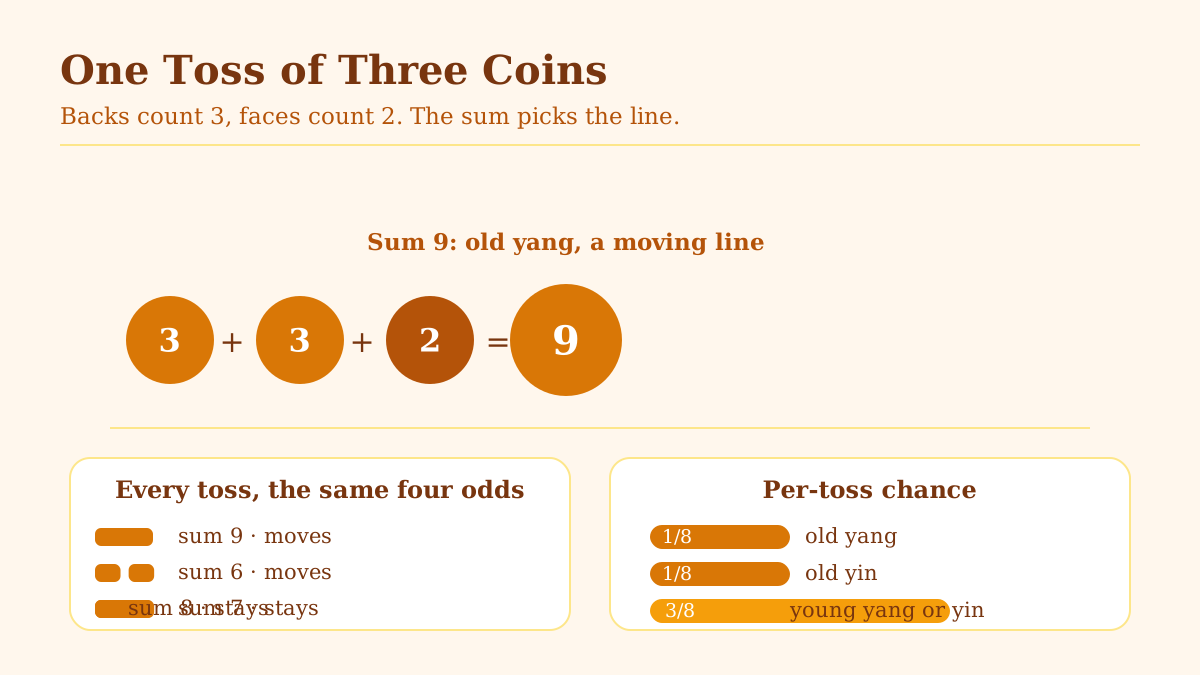
Start with one line. Three coins produce four outcomes: three heads (an old moving yang line, 1 in 8), two heads (a young yin line, 3 in 8), one head (a young yang line, 3 in 8), no heads (an old moving yin line, 1 in 8). Add them up and each line is yang with probability 1/2, yin with probability 1/2, static with probability 3/4, moving with probability 1/4.
Now the interesting part. Because each line is a fair 50/50 between yang and yin, all 64 primary hexagrams are exactly equally likely — Hexagram 1 and Hexagram 64 and everything between, one chance in 64 each. (The moving lines are where the asymmetry lives: only 17.8% of casts come out with no moving line at all, and the distribution of how many lines move is heavily skewed — which is why some casts feel "cleaner" than others.)
So what are the odds of casting the same hexagram twice in a row? 1/64 × 1/64 across two specific casts — but the question "does this cast match my previous one?" hits 1.56% of the time. That is roughly the same as rolling a specific pair with two dice: uncommon, unremarkable, and certain to happen eventually. Cast the coins 50 times over a year and the expected number of "same as last time" moments is about one. Cast 100 times — easy to do when you're anxious — and it's about two. The people who post "it keeps happening!" are, almost by definition, the people who cast the most.
The odds say a repeat is unremarkable. If you want to see how one cast actually unfolds, cast a hexagram now and read its moving lines against the hexagram you got.
Cast a hexagramWant the method behind the moving lines? Read What Do Moving Lines Mean in an I Ching Reading?. Or compare Coin Method vs Yarrow Stalks vs Online Casting.
What Memory Does With a Coincidence
Suppose you cast forty times across a season. Somewhere in there, twice, the same hexagram came back. What do you remember at the end of the season? The two matches — vivid, uncanny, story-shaped. The thirty-eight non-matches vanish; nobody builds an identity around "I asked about my job and got something different." Psychologists call the result selective recall, and it operates with special force on divination, because every cast arrives pre-loaded with meaning: the matches look like messages, the misses look like noise.
This is not a dismissal. Noticing patterns is what human minds are for, and the feeling that a repeatmeans something is worth taking seriously as information — about you. If the same hexagram keeps arriving when you ask about the same wound, the useful question is not "what is the coin trying to tell me" but "what is it that I keep not hearing?" The repeat is a mirror; you are the signal.
The Synchronicity Question — Honored, Not Worshipped
Most modern writing on this topic stops at Carl Jung's synchronicity — meaningful coincidence, an acausal connecting principle. Jung himself cast the I Ching for decades and wrote its foreword, and we are not going to sneer at the frame: for a lot of people it is the first honest vocabulary they find for experiences that statistics doesn't touch.
Our position is both/and. The probability says: repeats happen, at known rates, to everyone who casts. The synchronicity lens says: this repeat arrived now, about this question, and what you do with that is a matter of meaning, not mechanism. You can hold both without contradiction — the dice are fair, and the moment is still yours. What you should not do is let the second claim swallow the first, because that path ends with a coin flip running your life.
The Old Rule: 初筮告,再三渎,渎则不告
The tradition dealt with repeat-casting before probability existed, and its answer is blunt. Hexagram 4 (蒙, Youthful Folly) opens with the judgment: "The first divination gives light. Repeated and presumptuous questioning gives none." Ask once, sincerely, and the answer stands. Ask again because you didn't like the answer, and you're not divining anymore — you're shopping, and the oracle stops speaking.
Read as practice rather than threat, it is a rule about who the question belongs to. A cast you re-ask until it cooperates is not guidance; it is your anxiety holding the coins hostage. Most "helpful" repeat-casting is exactly that. The classic allows one honest exception, and it matters: whenthe situation itself has genuinely changed — the job you asked about in March is gone in June — you are not re-asking the same question, because it is no longer the same question. New moment, new cast, clean conscience. Re-asking an unchanged question to get a different answer is 渎. Asking a changed world a changed question is just paying attention.
So When Does a Repeat Deserve Attention?
After all that deflation, here is the constructive version — when we think a repeat is worth sitting with rather than shrugging off. All three should hold:
1. It survives the base rate. Twice in a row is 1.56% — noise. Five consecutive identical casts about the same question is 1-in-a-billion territory — at that point something is wrong with your coins, your method, or your week, and it's worth finding out which. (If you're literally getting the same result every time, check that you're actually re-randomizing — some bad web tools freeze the result.)2. The question is the same, and unresolved. A repeat on a question you already closed is a coincidence. A repeat on a question you've been circling for months is your own unfinished business showing up in costume. 3. You changed nothing and hoped the answer would change. That — per 蒙 — is the repeat that's actually about you.
Most "I keep getting the same hexagram" posts, read carefully, fail test 1 and pass test 3. The fix isn't more casting. It's one cast, read properly — including the moving lines, which most anxiety-casts never get read at all.
Not worried — but stop casting. Three casts in a row matching is about 1 in 4,096 by chance — rare, but it happens to someone every day at scale; if it's genuinely happening to you, first verify your method isn't freezing results (shake physical coins or use a tool that re-randomizes each cast). Then read Hexagram 4's judgment again — the tradition's answer to this exact situation is that repeated questioning ends the conversation.
Statistically, two casts in a row match 1.56% of the time — over a year of regular casting you should expect it once or twice. Whether it is additionally a sign is a question about meaning, not odds: the useful move is to ask what the hexagram says that you may have missed the first time, not to treat the repeat itself as a new message.
Hexagram 4 (蒙, Youthful Folly), the judgment: 初筮告,再三渎,渎则不告 — the first divination gives the answer; repeated questioning is presumption, and presumption gets no answer. One question, one cast, then live with the reading. Re-cast only when the situation itself has genuinely changed.
The primary hexagram — yes: each line is 50/50 yang or yin, so all 64 appear once in 64 casts on average. The moving lines are a different story: only 17.8% of casts have none, and the number of moving lines follows a skewed distribution. A "quiet" cast with no moving lines is less common than any specific hexagram being your primary one.
- Probabilities computed for the standard three-coin method and cross-checked against our own engine's line-type odds — see coins vs. yarrow stalks for how method changes the distribution.
- Hexagram 4 (蒙) judgment, Wilhelm/Legge renderings: "the first divination gives light; repeated questioning is presumption."
- Jung's foreword to the Wilhelm I Ching (1950) — the synchronicity frame, cited with respect and limits.
- Going deeper: what moving lines actually mean, the right time to cast, and how our engine works — honest odds included.