What Do Moving Lines Mean in an I Ching Reading?
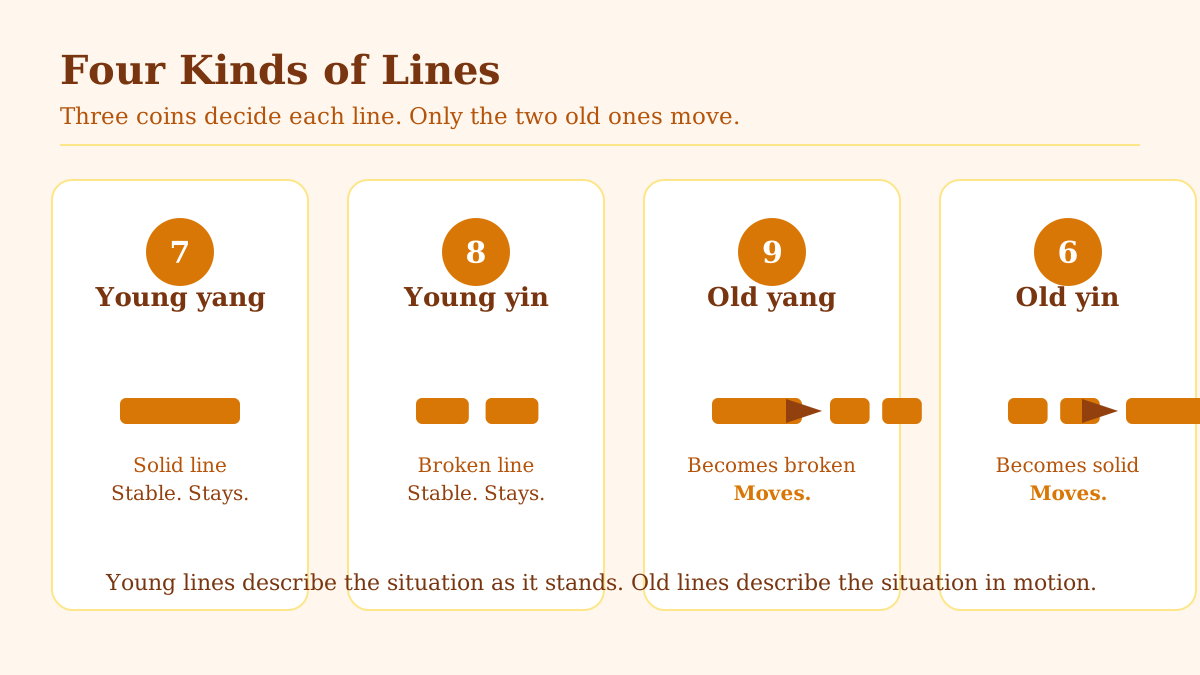
Moving lines are where the I Ching stops describing and starts moving. In plain terms: a moving line is a line that has reached the end of its stage and is about to flip to its opposite. A solid line marked old yang breaks into yin. A broken line marked old yin fills into yang. Flip every moving line and you get a second hexagram, the derived hexagram, and the pair of them tells you not just where you stand, but where you are heading. The moving line is the engine of that second half. This guide covers what makes a line old, how the odds work, and the exact order to read a cast that has them.
- A moving line is an old line. Tosses totaling 9 give old yang, which flips to broken; tosses totaling 6 give old yin, which flips to solid. Young lines, 7 and 8, never move.
- Moving lines carry the direction of the reading. Read the Judgment of the original hexagram, then each moving line from the bottom up, then the Judgment of the derived hexagram.
- They are common, not exotic. One toss in four produces a moving line, and most casts end up with one or two. All six moving: 1 in 4,096.
- The reading answers the question you asked. Phrase it well: how to ask the I Ching a question.
- Worked example: line 6 of hexagram 50 — the classical text, Legge's translation, and the hexagram this line becomes when it moves.
- Want to see it happen? Cast a hexagram and the marking and flipping are done for you, no tallying required.
Four Kinds of Lines, and Which Ones Move
Every line in a hexagram is one of four things. The name comes from the number that produced it, and the number comes from one toss of the coins: sum the values of the three faces, and the total is 6, 7, 8, or 9.
| Sum | Name | Line | Moves? | Per-toss odds |
|---|---|---|---|---|
| 7 | Young yang | Solid | No | 3/8 |
| 8 | Young yin | Broken | No | 3/8 |
| 9 | Old yang | Solid, flips to broken | Yes | 1/8 |
| 6 | Old yin | Broken, flips to solid | Yes | 1/8 |
The two young lines, 7 and 8, are stable. They describe your situation as it stands right now. The two old lines, 9 and 6, are moving: they come with a built-in direction. Old yang is solid yang at the peak of its strength, the moment before it breaks into yin. Old yin is broken yin at its darkest, ready to turn back toward light.
The mechanics take a paragraph to learn. The habit takes a few casts you actually sit with.
Free, no account. The app marks every moving line and builds the derived hexagram for you, so you can spend your attention on the reading instead of the tally.
Cast your first hexagramChanging Lines vs Moving Lines: Two Names, One Thing
Before going further, a vocabulary note that trips up almost everyone coming from books: changing lines and moving lines are the same thing. A line marked old yang or old yin is "moving" because it is in transition, and "changing" because it is about to change into its opposite. "Moving" is the older term and the one the classic translations lean on; "changing" is more common in modern English-language books. If your book says one and this guide says the other, nothing is in conflict. The lines that never move, young yang and young yin, are sometimes called "new" lines for the same reason — but young is the usual word, and it is the one used here.
Why Old Lines Move: the Peak-Turning Point
The word "old" is doing real work here. It does not mean aged or worn out. It means at the end of a stage, the way a season is old when it is about to hand over to the next one. The classic idea behind the I Ching is that a thing turns at its extreme: yang grows until it can grow no further, and then it becomes yin; yin sinks until it can sink no further, and then it becomes yang. That turning is what the book is named for. The Changes are not changes that happen to other people, they are changes that happen at the top and bottom of every cycle, including yours.
The same curve is why the tradition reads time itself in twelve stages: the Chinese zodiac years run a twelve-animal cycle of rise and decline, each year taking one position on the same clock face that a moving line marks inside a single cast.
Think of the brightest candle. It is brightest for a moment and then it is gone. The most confident point in an argument is also the moment of maximum exposure to being wrong. Old yang is that spot on the curve. Old yin is the bottom of the same curve, the point where the fall bottoms out and the ground gives way to rise again. Neither is praise or blame. A moving line is not a verdict on you, it is a position on a clock face. It says: here is where the momentum is, and it is about to change hands.
This is also the honest place to say what the I Ching is and is not. It does not whisper outcomes. It reads the shape of the change. If you are in an old yang position, the shape is: your strength is at its full extension, and strength at full extension begins to fold. That is not a prophecy about winning, it is a description of how attention and energy behave at their own extremes. The moving line exists to say which extreme you are standing on.
The visual shorthand works the same way, only flipped: a solid line that has become old turns into two broken segments, and the two segments of old yin join into one solid bar. The line does not disappear. It changes form. That single transformation, repeated for whatever moved, is the entire mechanics of the I Ching in miniature, and the rest of the reading hangs off it.
How the Toss Produces a Moving Line
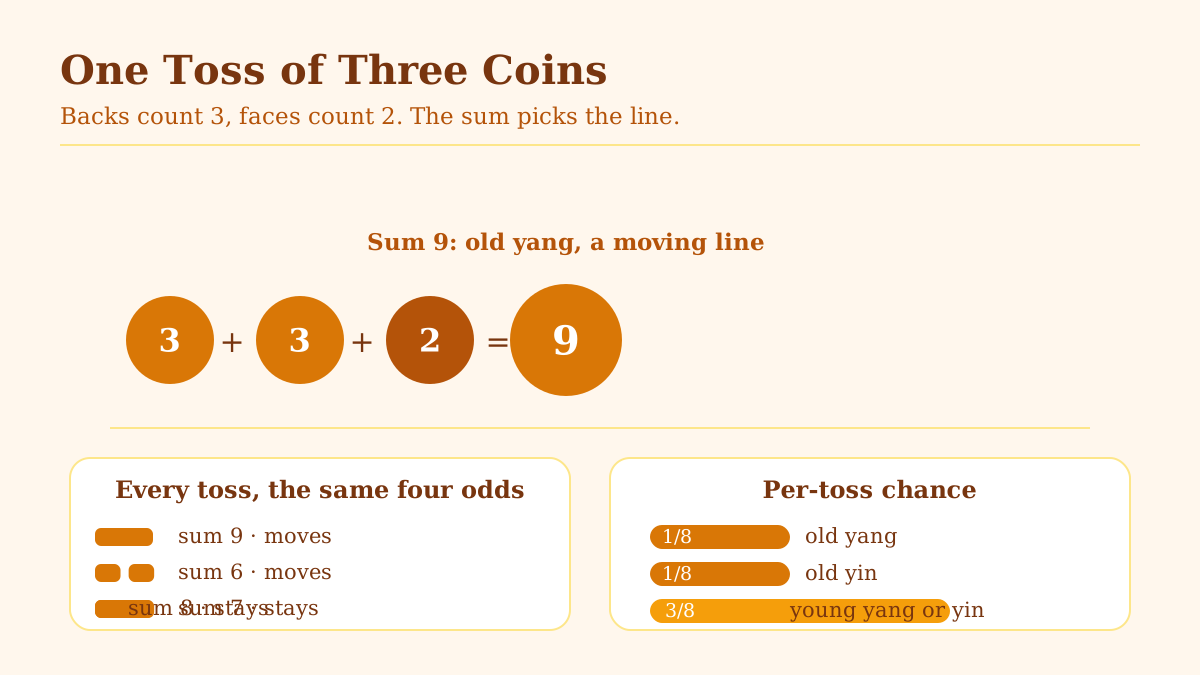
Coins make the decision mechanical, which is the point. You take three coins of the same kind, decide which face counts as 3 before you start, and toss all three six times, once per line, building from the bottom up. Each coin is either a back (counts 3) or a face (counts 2). Sum the three values.
| Backs up | Faces up | Sum | Line |
|---|---|---|---|
| 3 | 0 | 9 | Old yang, moves |
| 2 | 1 | 8 | Young yin, stays |
| 1 | 2 | 7 | Young yang, stays |
| 0 | 3 | 6 | Old yin, moves |
There are eight equally likely ways to throw three coins. Four of them give a young line, and four give a sum of 6 or 9. So each individual toss produces a moving line exactly one time in four. Over six tosses, that works out to a distribution you will feel in practice: roughly two casts in three come back with at least one moving line, and the single most common result is a cast with exactly one.
If you want the comparison to the older yarrow-stalk method, we run those numbers in the coin vs yarrow guide. The short version: stalks tilt the odds toward old yang, coins split the moving lines evenly. The method you choose changes the accent of your average reading, not the validity of it.
Original Hexagram and Derived Hexagram
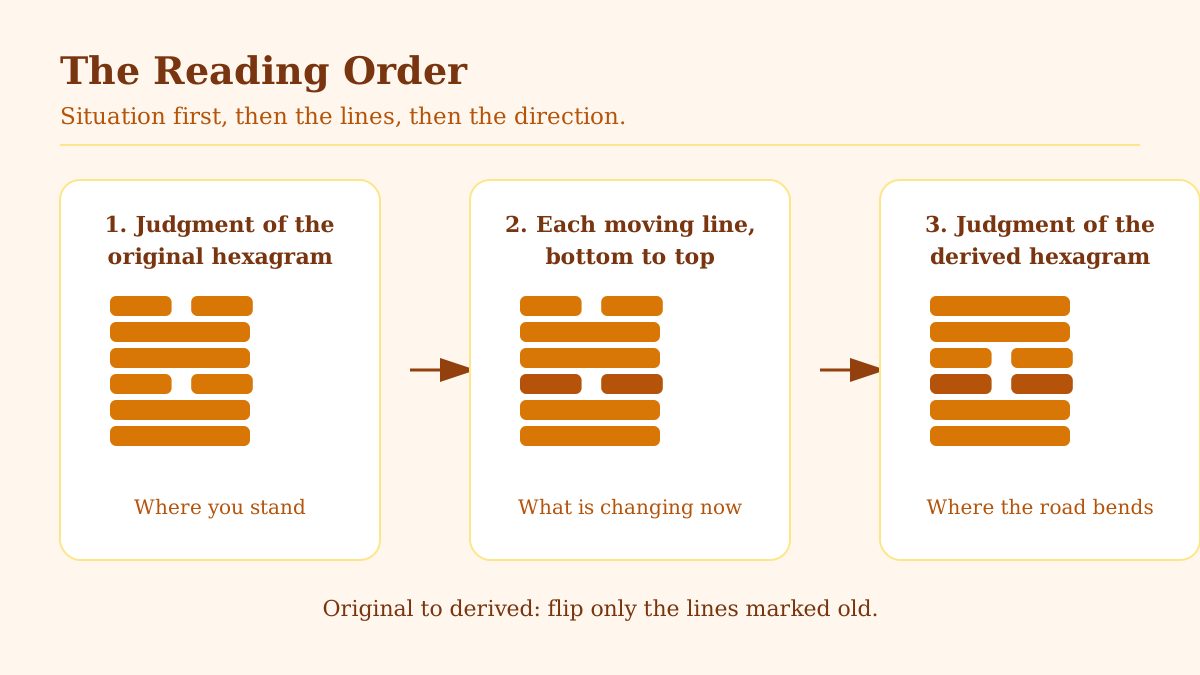
Six lines, recorded bottom to top, make one hexagram. The hexagram you cast first is the original hexagram, 本卦 in Chinese, the situation as it stands. Take every line that came up old and flip it, and you get the derived hexagram, 变卦, which is where the situation is heading. Two frames of the same story: where you are standing, and where the road bends.
Only the moving lines flip. You will never need to touch the young lines. If you redraw the whole stack, you have invented a third oracle that nobody asked for. The mechanics are unforgiving on this point precisely because they are so simple: the derived hexagram is the original hexagram with the old lines inverted, nothing else.
A worked example of the structure itself. Hexagram 1, the Creative, is six solid lines, the pure image of heaven, of initiative, of the force that starts things. If its bottom line comes up old, the derived hexagram becomes Hexagram 44, Coming to Meet, where a single yin line has entered from below. Same upper five lines, one changed line, a completely different picture. That is the sensitivity of the system: one line's worth of change can rearrange the whole reading. You can read the two poles of that example in full at Hexagram 1 and Hexagram 44.
How to Read a Cast with Moving Lines, in Order
The reading order is the one thing every school of the I Ching agrees on, so pin it down first and argue about everything else later:
- Read the Judgment of the original hexagram. This is the situation as cast, the frame the whole reading sits in.
- Read each moving line, from the bottom up. Line statements are the finest grain the oracle offers, specific to the exact position that is changing. The lowest moving line comes first, because time flows upward through the hexagram.
- Flip the moving lines and read the Judgment of the derived hexagram. This is the direction of travel: where this situation is heading if the change completes itself.
The step-by-step of turning any cast into a reading is walked through properly in how to interpret your reading.
When Only One Line Moves
The single moving line is the cleanest case, and the one classic readers love. The line text is the closest thing the I Ching has to a direct answer, because the whole system has narrowed to one precise position that is changing. Read it carefully, read it last, and treat it as the specific instruction the Judgment is still too general to give.
When Several Lines Move
With more than one moving line you enter the part of the practice where schools differ, and there is no single ancient rule. The conventions most English books teach today descend from later commentators, and the widely used set looks like this:
| Moving lines | What to read (common convention) |
|---|---|
| 0 | The Judgment of the original hexagram alone |
| 1 | That one moving line's text |
| 2 | Both moving line texts, the upper one leading |
| 3 | The Judgments of both hexagrams, original first |
| 4–5 | The one or two stable lines of the derived hexagram |
| 6 | The Judgment of the derived hexagram (in Hexagram 1 the "use of nine", in Hexagram 2 the "use of six") |
Treat these as a sensible default, not scripture. The tradition itself disagrees around the edges, and the many-moving-lines question gets its own deep sibling article. What no school disputes is the order above: original Judgment, moving lines, derived Judgment. If your book teaches a different convention for the count rules, use theirs, and use it consistently. A consistent method you trust beats a perfect method you keep second-guessing. For the two extreme poles of the sequence, see Hexagram 63 and Hexagram 64 — the only two hexagrams where every line is either perfectly placed or perfectly out of place, the completed task and the one still open, which is why they close the book.
What a Moving Line Actually Changes: a Worked Example
You ask about a stalled work situation. Not "will it work out," but "how should I handle the logjam with my team." You cast, and you get Hexagram 57, Gentle (the Wind), with the third line coming up old yang.
The Judgment of 57 is about influence that wins by persistence: wind over wind, the image of something that gets through by never stopping, and never raising its voice. That is your frame. The situation will not crack under pressure at the source; it yields to steady, patient application. The moving line is the third line, and the third line of 57 is famous in the tradition for the caution about effort applied at the wrong angle, pushing where pushing only fans the problem. Flip the third line, and the wind trigram becomes water, and the hexagram becomes Hexagram 59, Dispersion: what was held together comes apart.
Read in order, the message writes itself. The Judgment says the answer is patient pressure. The moving line says the one thing that endangers that patience is your own forcing. The derived hexagram says the end state of forcing is that things scatter, so the instruction is the opposite of the instinct: stop stirring, let the wind work. A static reading of 57 would have handed you only the first third of that. The moving line carried the actual instruction, and the derived hexagram carried the warning.
That is the pattern in miniature, and it is worth naming because it applies to every cast: Judgment sets the scene, moving lines name the actor, derived hexagram names the direction. You can read the derived hexagram of this example in full at Hexagram 59.
How Often Moving Lines Appear
The odds are worth having in your head, because they will save you from misreading your own casts. With the coin method, each toss is moving with probability 1/4, and the six tosses spread out like this:
| Moving lines | Share of casts | In everyday terms |
|---|---|---|
| 0 | 17.8% | about 1 cast in 6 |
| 1 | 35.6% | about 1 in 3, the single most common result |
| 2 | 29.7% | about 1 in 3 |
| 3 | 13.2% | about 1 in 8 |
| 4 | 3.3% | about 1 in 30 |
| 5 | 0.4% | about 1 in 228 |
| 6 | 0.02% | 1 in 4,096 |
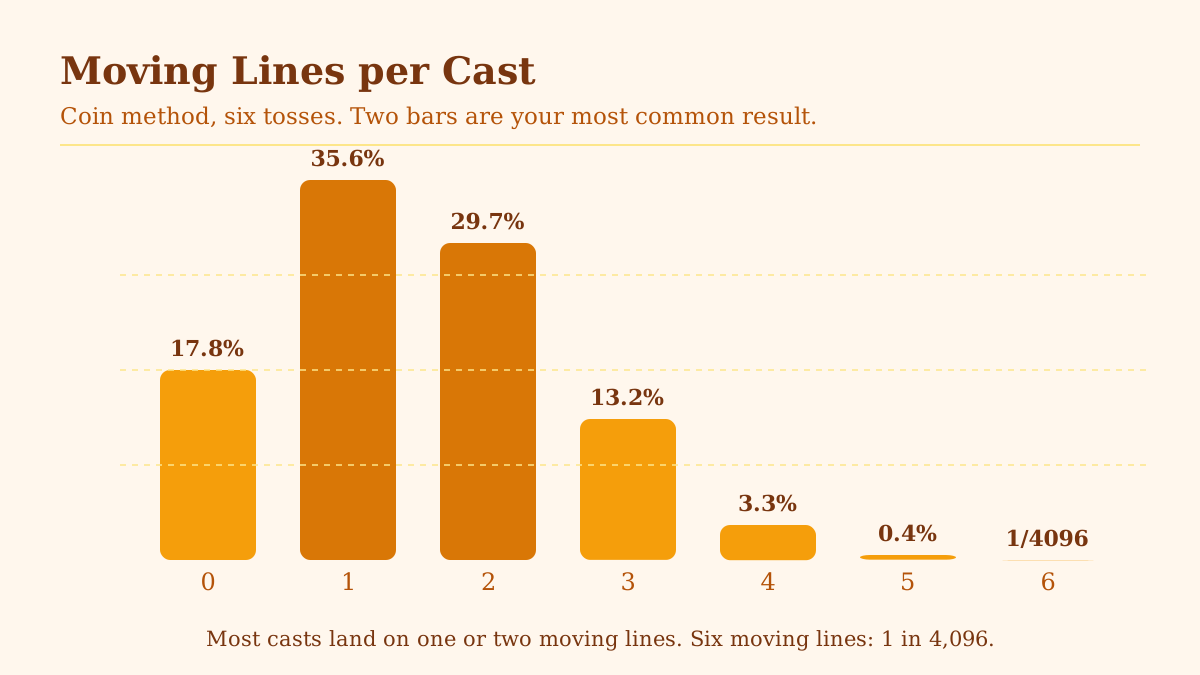
Two things fall out of this table. First, the typical cast has one or two moving lines: roughly two thirds of all casts land in those two rows. If your first few casts came back covered in moving lines, that is statistics, not a sign you did something wrong. Second, a perfectly static hexagram, no lines moving at all, is the minority case, about one cast in six. A clean hexagram is not a "better" hexagram. It is simply a reading about a situation that is not in transition, and the Judgment carries the whole answer.
What the Classic Text Says About Moving Lines
The idea that an old line is a line in transition is not an interpreter's invention. It is in the oldest layer of the book. The first line of the first hexagram puts the whole mechanic in one breath. Hexagram 1, the Creative, opens with a solid line at the bottom, and James Legge's 1899 translation reads:
In the first (or lowest) line, undivided, (we see its subject as) the dragon lying hid (in the deep). It is not the time for active doing.
A hidden dragon is still a dragon. The line is strong, the power is real, but the moment has not arrived. The line statement is doing exactly what the section above said it does: it takes the Judgment's general claim, strength and initiative, and makes it specific in time. The dragon is not hidden forever. The line is old the moment it starts to move, and the text at that moment is the timing.
The book even has a passage for the extreme case, all six lines moving in the Creative, and it is one of the strangest and most quoted lines in the whole text. Legge renders the "use of nine":
(The lines of this hexagram are all strong and undivided, as appears from) the use of the number nine. If the host of dragons (thus) appearing were to divest themselves of their heads, there would be good fortune.
Six yang lines at full strength, six dragons all leading, and the text says: take off the heads. The image is the opposite of doubling down. When every line moves, the answer is not more will. It is less head, more body. The collective action of the dragons matters more than any single dragon's direction. That is the tradition's own reading of the most moving line possible: an extreme of yang, and the instruction is to yield the lead.
None of this is fortune-telling in the modern sense. The classic text is uninterested in whether you will win. It is interested in whether you are at the beginning of a stage, in the middle of it, or at the moment of its turning. The moving lines are the places where that question gets asked about you, directly.
Common Mistakes
Flipping the non-moving lines too. Only old yang and old yin transform. Young yang stays solid, young yin stays broken, no exceptions. If you redraw the whole hexagram because one line moved, you have changed the question the oracle answered. The derived hexagram is the original with the old lines inverted, and only them.
Reading the derived hexagram's line texts. The moving lines belong to the first hexagram. Once you have built the derived hexagram, you read its Judgment, not its individual lines, under the common convention. If you start reading line texts from the derived hexagram, you are reading advice for a situation you are not in yet.
Treating a moving line as a bad omen. Old yin turning to yang is movement toward light. Old yang turning to yin is a peak passing. Neither one is punishment. Both are timing. The people who get the most out of this book are the ones who stop grading the lines as good or bad and start reading them as clocks.
Skipping the original hexagram because something moved. The moving line makes sense only against the Judgment it grew out of. Read the whole cast, in order, every time. The moment you start reading only the "exciting" part, you are reading a fragment as if it were the answer.
Re-asking the same question to get a nicer answer. The classics are blunt about this. One question, one cast, then work with it. If the first answer makes you uncomfortable, the discomfort is usually the point. The counter-question to cast is not the same question again, it is about what you are willing to change.
FAQ
A moving line is a line that has reached the end of its stage and is about to flip to its opposite: old yang (sum 9) becomes a broken line, old yin (sum 6) becomes a solid line. The moving lines of a cast mark what is changing, and flipping them produces the derived hexagram, the direction the situation is heading.
Because the book is built on the observation that things turn at their extreme. Yang grows until it becomes yin, yin sinks until it becomes yang. A line is marked "old" when it sits at that turning point, and the derived hexagram shows the result of the turn.
Young yang (7) and young yin (8) are stable: they describe the situation as it stands. Old yang (9) is a solid line at full strength that moves to broken. Old yin (6) is a broken line at full depth that moves to solid. Only the two old lines move.
In three steps. Read the Judgment of the original hexagram, read each moving line from the bottom up, then flip the moving lines and read the Judgment of the derived hexagram. This order is the one part of the practice every school agrees on.
Both, in that order. The original is where you stand, the derived is where the road bends. The moving lines are the hinge between them. Once you have both Judgments and the line texts, the reading is the arc from one to the other.
No. They are two names for the same line: one marked old yang or old yin, which flips to its opposite in the derived hexagram. "Moving" is the older term; "changing" is more common in modern English books.