How to Ask the I Ching a Question
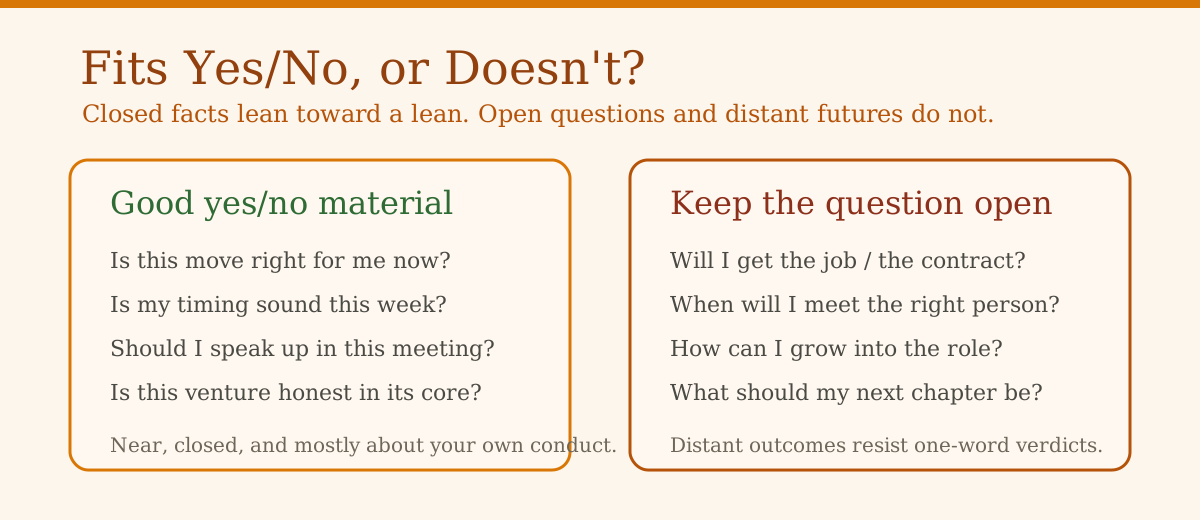
Most disappointing readings are not bad casts. They are good casts of bad questions. "Will I get the job?" produces a flat, anxious, yes-or-no-shaped reading. "What do I most need to understand about this job offer?" produces something you can actually use. The coins didn't change — the question did. This is the guide to the half of divination that happens before you shake.
- Ask about the situation, not the verdict. "What do I need to see about X?" beats "Will X happen?" every time — open questions produce layered readings, verdict questions produce coin-flip anxiety.
- One question per cast. Two questions in one cast gives you two half-answers. (And per Hexagram 4's judgment — 初筮告,再三渎 — re-casting the same question to shop for a better answer ends the conversation.)
- Avoid questions with only two possible answers. Yes/no casts are real but blunt — most situations deserve the full 64-hexagram vocabulary, not a bit.
- Timing questions have their own grammar — "when" questions work, but ask about the situation's movement, not for a date.
Why the Question Is Half the Reading
A cast does not read your mind; it answers the question you held while shaking. Hold a vague anxiety and the answer arrives as a vague mirror of it. Hold a precise question and the same six lines read like a direct memo. Every experienced practitioner has watched one hexagram mean completely different things for two people — and the difference is almost always the question, not the hexagram.
The classical texts hint at this constantly. Readings in the Zuo Zhuan are answers to specific, concrete, situational questions — never "tell me my future," always "what about this alliance,this campaign, this marriage." The oracle was built for specific questions. It still is.
Write your question down before you cast, in one sentence about one situation. Then cast and check whether the six lines answer that exact question or drift toward a different one.
Cast with a clear questionAsking about a relationship? Read I Ching for Love: How to Ask About a Relationship. Framing a yes-or-no? See I Ching Yes or No: When a Single Hexagram Answers.
Open vs. Closed: the One Rule That Does 80% of the Work
Closed questions ("Will it work?", "Is he lying?", "Should I move?") force the reading into a verdict format. You get a lean answer, you squint at it, and because it didn't say what you hoped, you cast again — and now you're shopping, which is where repeat-casting trouble starts.
Open questions ("What do I need to understand about…?", "What is happening beneath the surface of…?", "What should I keep in mind as I…?") let the full reading speak: the primary hexagram as the situation's shape, the moving lines as the dynamics, the resulting hexagram as the direction. The same information arrives, but with room to be useful.
The practical trick if you're attached to a yes/no framing: cast the open version, and let the hexagram's overall bearing answer the yes/no implicitly. A reading of Hexagram 11 (泰, Peace) about "what do I need to know about this partnership" is a yes wearing better clothes than any bare yes/no cast would give you.
Bad Questions, Rewritten
Four patterns cover most bad questions. Each rewrite keeps the same situation:
| Pattern | As first asked | Rewritten | Why |
|---|---|---|---|
| Verdict-seeking | "Will I get the job?" | "What do I most need to understand about this job offer?" | You get usable material either way — and if the reading is about a red flag, you'll actually see it before signing, which "will I get it" can never tell you. |
| Mind-reading others | "Does she still love me?" | "What is really happening between us right now?" | You can't cast about her interior; you can cast about the space between you. Also the only version whose answer you could act on. |
| Two questions, one cast | "Should I quit, and where should I go?" | Cast 1: "What do I need to know about leaving this job?" — later, if needed — Cast 2: "What should I weigh in choosing the next place?" | Two questions in one cast is two half-readings tangled together. Sequential casts keep each answer clean. |
| Future-fishing | "When will I meet someone?" | "What stands between me and the relationship I want?" | "When" without a situation invites a fortune-cookie answer. Asking about the obstacle produces something you can work on while you wait. |
The Legitimate Yes/No Question
Sometimes you genuinely need a yes or a no — the lease is up Friday, the information you need is binary. For those, there is a real technique: many practitioners read a cast's bearing (favorable hexagrams, favorable lines = yes-leaning), and there are dedicated methods for coin-flavored yes/no oracles. We built a whole guide for this case: how to ask the I Ching yes-or-no questions — including which hexagram features count as green lights. Use it for genuinely binary stakes, not as a shortcut around doing the reading.
Timing Questions: Ask About Movement, Not Dates
"When will X happen?" is one of the most-cast and worst-answered questions in divination. The I Ching thinks in seasons and conditions — hexagrams literally are named after times of year and times of life. The workable version of a timing question is "what would have to change before X can move?" or "is now the moment to push, or the moment to wait?" The reading then answers in its native grammar: Hexagram 5 (需, Waiting) about pushing forward now is a calendar in disguise. We cover the ritual and the rhythm of this in when to cast.
What Not to Ask at All
Three categories the tradition itself fences off — and we hold the same line on this site: death and health (a cast is not a diagnosis, and the tradition treats medical questions as belonging to physicians); third parties' private choices (you cannot cast someone else's will — ask about the situation between you instead); and casino questions (lottery numbers, match outcomes, markets — questions with no self in them produce readings with no self in them). None of this is prudishness; it is what the oracle is structurally good at. A cast is a mirror held up to your situation andyour part in it. Ask within that frame and it is startlingly articulate.
Open and situational: "What do I most need to understand about X?" or "What should I keep in mind regarding X?" — one question per cast, about your situation and your part in it, rather than a verdict about an outcome or another person's private will.
Yes, sparingly, with a dedicated method — favorable hexagrams and favorable lines read as green lights. See our yes/no guide for the specifics. For most situations, an open question produces a richer and more actionable reading than a bare yes/no.
Not their private mind or choices — you cannot cast someone else's will. You can cast about the situation you share: "What is really happening between us?" works; "Does she love me?" doesn't. The love-specific version of this question has its own guide.
No. The classical judgment on Hexagram 4 (蒙): the first divination gives the answer, repeated questioning is presumption and gets no answer. Re-cast only when the situation itself has genuinely changed. More on this in our piece on repeat casts.
- The question-first frame follows classical practice: divinations recorded in the Zuo Zhuan answer specific situational questions, never generic fortune-telling.
- Hexagram 4 (蒙) judgment — 初筮告,再三渎,渎则不告 — the tradition's own rule against re-casting an unchanged question.
- Deeper on each spoke: asking about love · yes/no casts · when to cast · reading the answer · repeats & re-casting.
- Ready to cast a well-formed question? Cast it here — free, no account.